Electric Flux and Potential for Charge Outside Hemispherical Surface
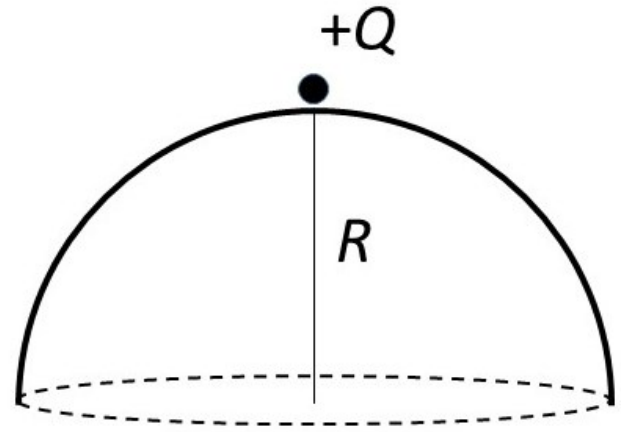
A point charge is located just outside an imaginary hemispherical surface with radius , as depicted in the figure. Which among the following statements is/are correct?
Options
The electric flux passing through the curved surface of the hemisphere is
Total flux through the curved and the flat surfaces is
The component of the electric field normal to the flat surface is constant over the surface
The circumference of the flat surface is an equipotential
Topics & Concepts
Step-by-Step Solution
To determine the correct statements, let us analyze each option individually using the principles of electrostatics and Gauss's Law.
1. Analysis of Option [A] and Option [B] (Electric Flux)
Let us set up a coordinate system where the center of the flat circular base of the hemisphere is at the origin .
- The flat surface lies in the -plane () with radius , i.e., .
- The curved surface is the upper hemisphere defined by for .
- The point charge is located just outside the apex of the hemisphere at .
Since the charge lies strictly outside the closed surface formed by the curved surface and the flat base, the total enclosed charge is .
By Gauss's Law:
Therefore, the total flux through the combined curved and flat surfaces is . This shows that Statement [B] is incorrect.
To find the flux passing through the flat surface, consider the cone formed with vertex at and base as the circular flat surface. The radius of this flat disk is , and the distance from to the center of the disk is .
The semi-vertical angle of this cone is:
The solid angle subtended by the flat base at the position of is given by:
The flux of the electric field originating from that passes through the flat surface is:
Since , the net electric flux passing through the curved surface is:
Hence, Statement [A] is correct.
2. Analysis of Option [C] (Normal Component of Electric Field)
Consider a point on the flat surface at a distance from the center , where .
The distance from the charge to this point is:
The magnitude of the electric field at this point is:
The normal component of the electric field (perpendicular to the flat surface, along the -axis) is:
As varies from at the center to at the boundary, changes continuously. Thus, the normal component of the electric field is not constant over the flat surface.
Hence, Statement [C] is incorrect.
3. Analysis of Option [D] (Equipotential Circumference)
The circumference of the flat base consists of all points lying on the circle .
The distance from to any point on this circumference is:
The electric potential at any point on the circumference due to the point charge is:
Since the potential is uniform at every point along the circumference, the circumference of the flat surface is indeed an equipotential line.
Hence, Statement [D] is correct.
Conclusion
- Correct Options: A and D