Identify Reactions Yielding Aromatic Compound as Major Product
Select the correct option(s) that produce an aromatic compound as the major product.
Options

Topics & Concepts
Step-by-Step Solution
To determine which of the given reactions produce an aromatic compound as the major product, we analyze each option individually:
Option (A)
-
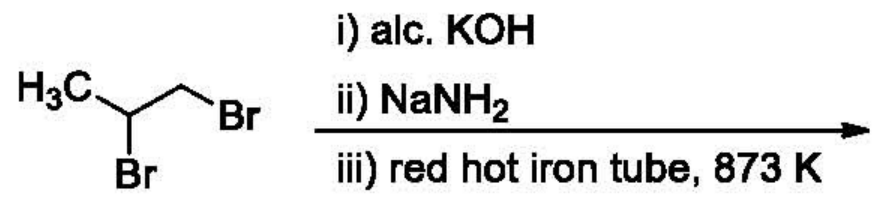
First & Second Steps (Dehydrohalogenation): Treatment of -dibromopropane () with alcoholic eliminates one molecule of to form 2-bromopropene. Subsequent reaction with a stronger base, sodium amide (), eliminates a second molecule of to give propyne:
-
Third Step (Cyclotrimerization): When three molecules of propyne are passed through a red-hot iron tube at , they undergo cyclic trimerization to form -trimethylbenzene (mesitylene):
Since mesitylene is a substituted benzene derivative containing a planar, fully conjugated cyclic ring with delocalized electrons, it is aromatic. Thus, Option (A) is correct.
Option (B)
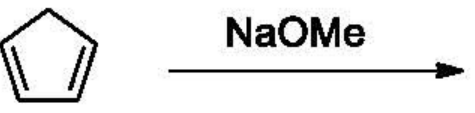
- Cyclopentadiene has a pair of acidic hydrogen atoms at the hybridized position ().
- Reaction with the base sodium methoxide () results in the deprotonation of cyclopentadiene:
- The cyclopentadienyl anion is cyclic, planar, completely conjugated, and contains electrons ( where ). According to Hückel's rule, it is aromatic. Thus, Option (B) is correct.
Option (C)
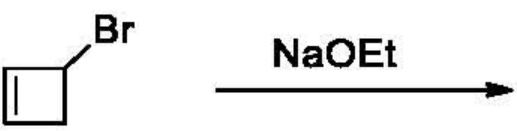
- Treatment of 3-bromocyclobutene with sodium ethoxide () leads to elimination to give cyclobutadiene or substitution products.
- Cyclobutadiene is a cyclic, planar molecule with electrons ( electrons where ), which makes it anti-aromatic and extremely unstable.
- Neither the elimination nor substitution product yields an aromatic compound. Thus, Option (C) is incorrect.
Option (D)
- In the presence of ultraviolet light () at , benzene undergoes a free-radical addition reaction with excess chlorine ():
- The product formed is -hexachlorocyclohexane (Benzene Hexachloride / BHC).
- This molecule contains only hybridized carbons with no delocalized -electrons, making it non-aromatic. Thus, Option (D) is incorrect.
Conclusion
The correct options that produce an aromatic compound as the major product are (A) and (B).