To determine the correct option(s), let us trace each step of the reaction sequence:
Step 1: Conversion to Q
The starting material is:
4-MeO−C6H4−C≡C−CH2−CHO
Hydration (Hg2+,dil. H2SO4):
Hydration of the internal alkyne occurs via the more stable benzylic carbocation-like intermediate, directed by the electron-donating 4-methoxyphenyl ring:
4-MeO−C6H4−C≡C−CH2−CHOHg2+,dil. H2SO44-MeO−C6H4−C(=O)−CH2−CH2−CHO
Selective Oxidation (AgNO3,NH4OH):
Tollens' reagent selectively oxidizes the aldehyde group to a carboxylic acid, leaving the ketone unaffected:
4-MeO−C6H4−C(=O)−CH2−CH2−CHOAgNO3,NH4OH4-MeO−C6H4−C(=O)−CH2−CH2−CO2H
Clemmensen Reduction (Zn-Hg,conc. HCl):
The keto carbonyl group is completely reduced to a methylene group (−CH2−), while the carboxylic acid group remains intact:
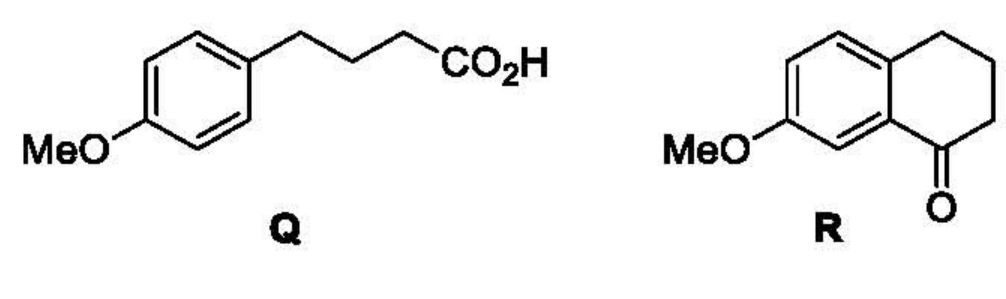
Q=4-MeO−C6H4−CH2−CH2−CH2−CO2H
This structure matches Q shown in Option (C).
Step 2: Conversion of Q to R
Acyl Chloride Formation (SOCl2,pyridine):
The carboxylic acid Q is converted to the corresponding acyl chloride:
QSOCl2,pyridine4-MeO−C6H4−CH2−CH2−CH2−COCl
Intramolecular Friedel-Crafts Acylation (AlCl3):
The acylium ion attacks the position ortho to the alkyl chain (forming a stable 6-membered ring) to produce 6-methoxy-3,4-dihydronaphthalen-1(2H)-one (6-methoxy-1-tetralone):
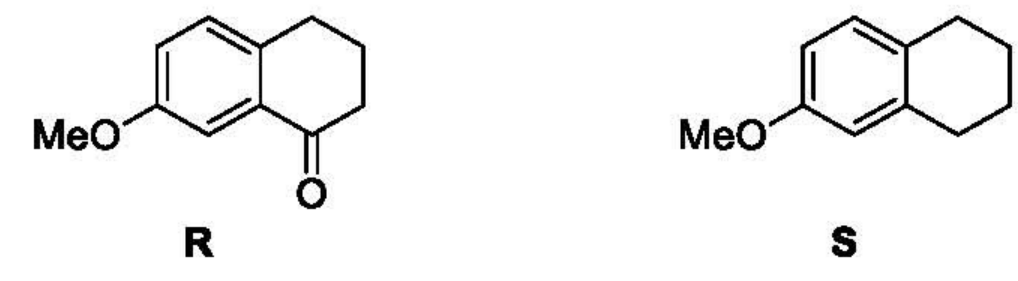
R=6-methoxy-1-tetralone
This structure matches R shown in Option (C) and Option (D).
Step 3: Conversion of R to S
Clemmensen Reduction (Zn-Hg,conc. HCl):
The carbonyl group of 6-methoxy-1-tetralone is reduced to a −CH2− group, yielding 6-methoxytetralin (6-methoxy-1,2,3,4-tetrahydronaphthalene):
S=6-methoxytetralin
This structure matches S shown in Option (D).
Conclusion:
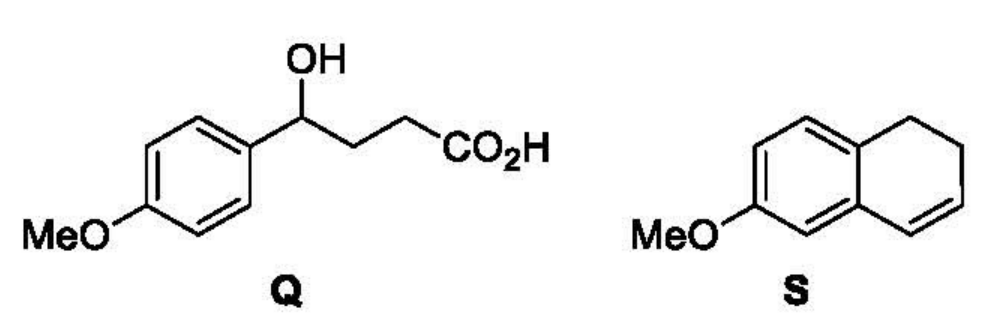
Option (A) is incorrect because Q has an −OH group instead of −CH2−, and S is partially oxidized/unsaturated.
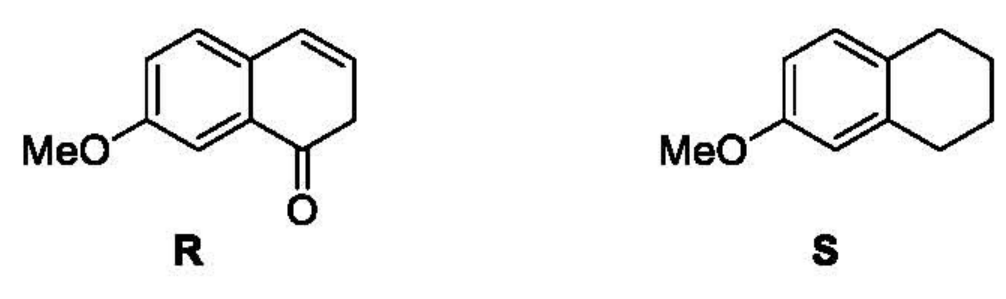
Option (B) is incorrect because R has an unsaturated ring.
Option (C) correctly depicts the structures of Q and R.
Option (D) correctly depicts the structures of R and S.