Identify Chemical Structure of Cellulose Triacetate
Cellulose upon acetylation with excess acetic anhydride/ (catalytic) gives cellulose triacetate whose structure is
Options
Topics & Concepts
Step-by-Step Solution
To determine the correct chemical structure of cellulose triacetate, we analyze the structure of cellulose and the effect of complete acetylation:
-
Structure of Cellulose:
Cellulose is a linear polymer composed of -glucose monomeric units joined by -glycosidic linkages.
Due to the geometry of the linkage, adjacent glucose units are flipped by relative to one another along the polymer chain to maintain a linear, extended ribbon-like conformation. -
Acetylation Reaction:
Each -glucose unit in cellulose contains three free hydroxyl () groups:- Secondary groups at and
- Primary group at (in the group attached to )
When cellulose is treated with excess acetic anhydride in the presence of a catalytic amount of , all three groups per monomer unit undergo acetylation to form acetoxy () groups:
-
Comparison of the Options:
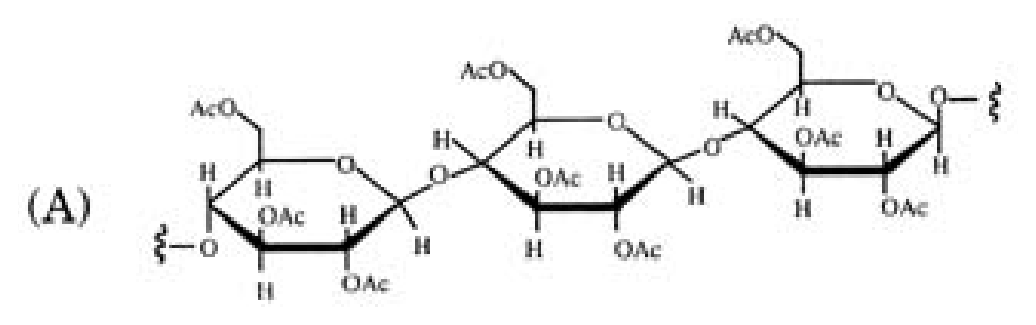
- Structure (A) correctly depicts the alternating inverted pyranose rings characteristic of the -glycosidic linkages of cellulose, with complete acetylation at positions , , and ().
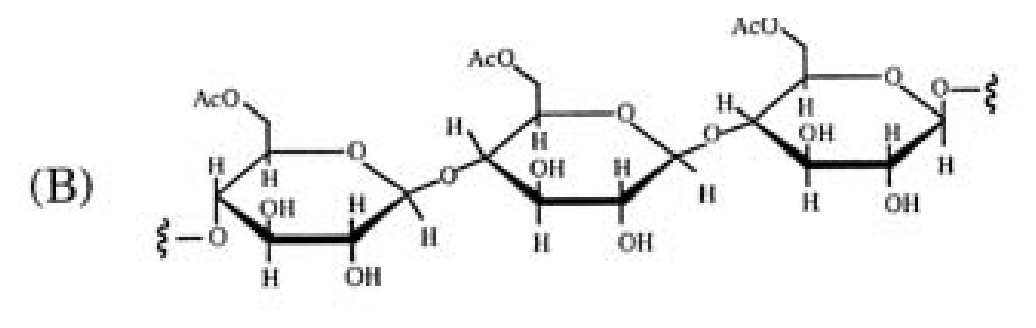
- Structure (B) contains unreacted groups at and , representing incomplete acetylation.
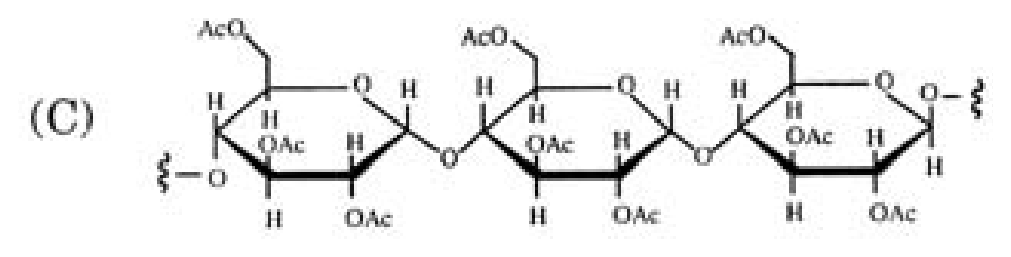
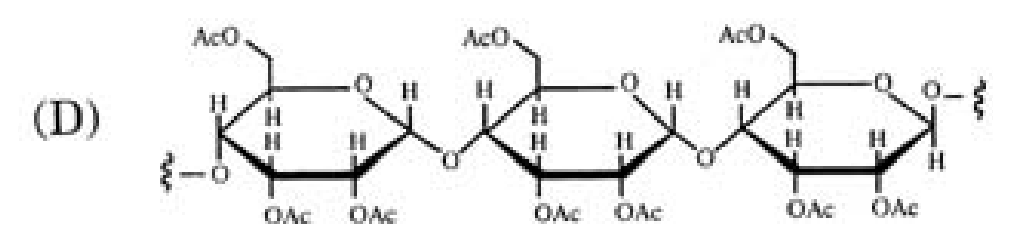
- Structures (C) and (D) show non-inverted pyranose rings aligned in the same direction, which corresponds to -glycosidic linkages found in amylose (starch) rather than cellulose.
Thus, structure (A) correctly represents cellulose triacetate.
Correct Answer: A