JEE Challenger
More from Aldehydes, Ketones and Carboxylic Acids

Determine Structures of Products E F and G in Labelled Decarboxylation and Haloform Reaction

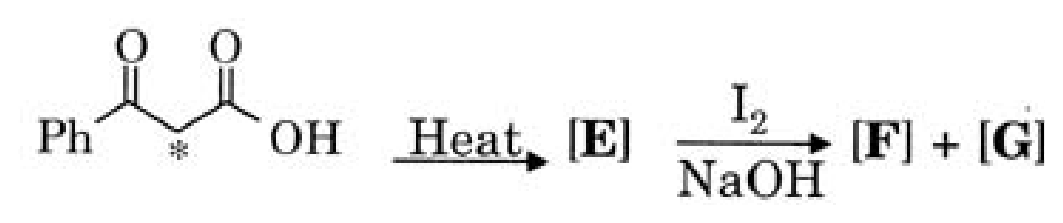
In the following reaction sequence, the correct structures of E\mathbf{E}, F\mathbf{F} and G\mathbf{G} are

(* implies 13C^{13}\text{C} labelled carbon)

Diagram 0

Options

A
Option A Diagram 1
B
Option B Diagram 1
C
Option C Diagram 1
Correct
D
Option D Diagram 1

Step-by-Step Solution

To determine the structures of products E\mathbf{E}, F\mathbf{F}, and G\mathbf{G}, we analyze the reaction sequence step-by-step:

Step 1: Decarboxylation to form Product [E]

The starting material is a β\beta-keto acid labelled with 13C^{13}\text{C} at the α\alpha-position:
Ph−C(=O)−C∗H2−COOH\text{Ph}-\text{C}(=\text{O})-\overset{*}{\text{C}}\text{H}_2-\text{COOH}

Upon heating, β\beta-keto acids undergo thermal decarboxylation via a six-membered cyclic transition state to form an enol intermediate:
Ph−C(=O)−C∗H2−COOH→ΔPh−C(OH)=C∗H2+CO2\text{Ph}-\text{C}(=\text{O})-\overset{*}{\text{C}}\text{H}_2-\text{COOH} \xrightarrow{\Delta} \text{Ph}-\text{C}(\text{OH})=\overset{*}{\text{C}}\text{H}_2 + \text{CO}_2

Tautomerization of the enol intermediate yields labelled acetophenone:
E=Ph−C(=O)−C∗H3\mathbf{E} = \text{Ph}-\text{C}(=\text{O})-\overset{*}{\text{C}}\text{H}_3


Step 2: Haloform Reaction to form Products [F] and [G]

When compound E\mathbf{E} (Ph−C(=O)−C∗H3\text{Ph}-\text{C}(=\text{O})-\overset{*}{\text{C}}\text{H}_3) reacts with iodine in the presence of sodium hydroxide (I2/NaOH\text{I}_2 / \text{NaOH}), it undergoes the haloform reaction:

  1. The acidic hydrogens on the labelled methyl group (C∗H3\overset{*}{\text{C}}\text{H}_3) are replaced by iodine atoms to form a triiodomethyl ketone intermediate:
    Ph−C(=O)−C∗I3\text{Ph}-\text{C}(=\text{O})-\overset{*}{\text{C}}\text{I}_3
  2. Nucleophilic attack by hydroxide ion (OH−\text{OH}^-) on the carbonyl carbon leads to the cleavage of the C−C∗\text{C}-\overset{*}{\text{C}} bond, producing sodium benzoate (F\mathbf{F}) and labelled iodoform (G\mathbf{G}):
    Ph−C(=O)−C∗I3+NaOH→Ph−C(=O)O−Na++C∗HI3\text{Ph}-\text{C}(=\text{O})-\overset{*}{\text{C}}\text{I}_3 + \text{NaOH} \rightarrow \text{Ph}-\text{C}(=\text{O})\text{O}^-\text{Na}^+ + \overset{*}{\text{C}}\text{HI}_3

Thus, the reaction products are:

  • F=Ph−COO−Na+\mathbf{F} = \text{Ph}-\text{COO}^-\text{Na}^+
  • G=C∗HI3\mathbf{G} = \overset{*}{\text{C}}\text{HI}_3

Conclusion:

  • E=Ph−C(=O)−C∗H3\mathbf{E} = \text{Ph}-\text{C}(=\text{O})-\overset{*}{\text{C}}\text{H}_3
  • F=Ph−C(=O)O−Na+\mathbf{F} = \text{Ph}-\text{C}(=\text{O})\text{O}^-\text{Na}^+
  • G=C∗HI3\mathbf{G} = \overset{*}{\text{C}}\text{HI}_3

This matches the structures provided in Option C.