Determination of Isochoric Steps in a Gas Cycle
Comprehension Passage
A fixed mass '' of a gas undergoes a series of cyclic state transformations from state to to to and returns back to as depicted in the Pressure-Volume plot below.
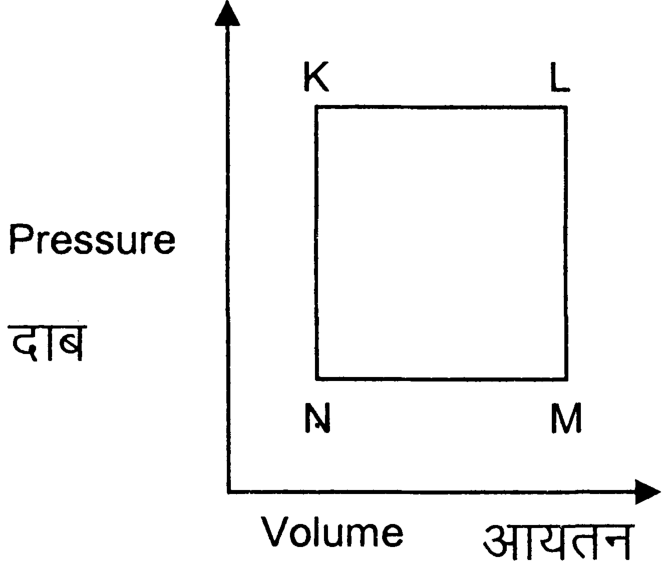
Which of the following pairs represents the isochoric processes among these state transformations?
Options
A
to and to
BCorrect
to and to
C
to and to
D
to and to
Topics & Concepts
Step-by-Step Solution
An isochoric process is a thermodynamic process in which the volume () of a closed system remains constant ().
In a (Pressure vs. Volume) diagram:
- A process represented by a horizontal line (parallel to the Volume axis) occurs at constant pressure, which corresponds to an isobaric process.
- A process represented by a vertical line (parallel to the Pressure axis) occurs at constant volume, which corresponds to an isochoric process.
Analyzing each transformation in the given cyclic path :
- Process : The path is a horizontal line, so pressure remains constant. Hence, it is an isobaric process.
- Process : The path is a vertical line, so volume remains constant (). Hence, it is an isochoric process.
- Process : The path is a horizontal line, so pressure remains constant. Hence, it is an isobaric process.
- Process : The path is a vertical line, so volume remains constant (). Hence, it is an isochoric process.
Therefore, the pair of transformations representing isochoric processes is and .
Correct Answer: (B)