JEE Challenger
More from Aldehydes, Ketones and Carboxylic Acids

Identification of Organic Compound Y from Multistep Synthesis Involving Perkin Reaction

Comprehension Passage

Benzene is treated with CO/HCl\text{CO}/\text{HCl} in the presence of anhydrous AlCl3/CuCl\text{AlCl}_3/\text{CuCl} followed by reaction with Ac2O/NaOAc\text{Ac}_2\text{O}/\text{NaOAc} to yield compound X\mathbf{X} as the predominant product. Compound X\mathbf{X}, upon reacting with Br2/Na2CO3\text{Br}_2/\text{Na}_2\text{CO}_3 followed by heating at 473 K473\text{ K} with moist KOH\text{KOH}, produces compound Y\mathbf{Y} as the major product. Treatment of X\mathbf{X} with H2/Pd-C\text{H}_2/\text{Pd-C}, followed by heating with H3PO4\text{H}_3\text{PO}_4, furnishes compound Z\mathbf{Z} as the major product.

Identify the structure of the compound Y\mathbf{Y}:

Options

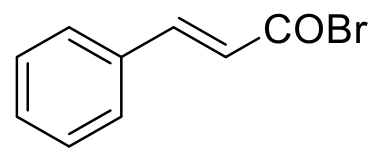
A
Option A
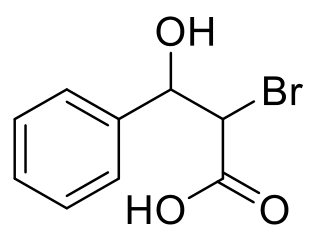
B
Option B
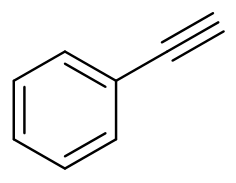
C
Option C
Correct
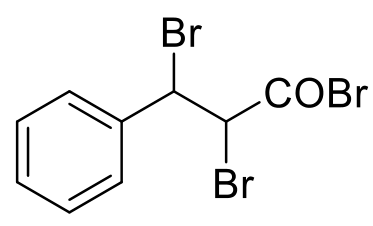
D
Option D

Step-by-Step Solution

To determine the structure of compound Y\mathbf{Y}, we analyze the reaction sequence step-by-step:

  1. Formation of Compound X\mathbf{X}:

    • Step 1 (Gattermann-Koch reaction): Benzene is treated with CO\text{CO} and HCl\text{HCl} in the presence of anhydrous AlCl3/CuCl\text{AlCl}_3/\text{CuCl} to form benzaldehyde: C6H6+CO+HCl→AlCl3/CuClC6H5CHO+HCl\text{C}_6\text{H}_6 + \text{CO} + \text{HCl} \xrightarrow{\text{AlCl}_3/\text{CuCl}} \text{C}_6\text{H}_5\text{CHO} + \text{HCl}

    • Step 2 (Perkin reaction): Benzaldehyde is subsequently reacted with acetic anhydride (Ac2O\text{Ac}_2\text{O}) in the presence of sodium acetate (NaOAc\text{NaOAc}) to furnish cinnamic acid as the predominant product X\mathbf{X}: C6H5CHO+(CH3CO)2O→CH3COONa, ΔC6H5−CH=CH−COOH(X)\text{C}_6\text{H}_5\text{CHO} + (\text{CH}_3\text{CO})_2\text{O} \xrightarrow{\text{CH}_3\text{COONa}, \, \Delta} \text{C}_6\text{H}_5-\text{CH}=\text{CH}-\text{COOH} \quad (\mathbf{X})

  2. Formation of Compound Y\mathbf{Y}:

    • Step 1 (Bromination): Cinnamic acid (X\mathbf{X}) undergoes electrophilic addition of bromine (Br2/Na2CO3\text{Br}_2/\text{Na}_2\text{CO}_3) across the carbon-carbon double bond to yield 2,3-dibromo-3-phenylpropanoic acid (cinnamic acid dibromide): C6H5−CH=CH−COOH→Br2/Na2CO3C6H5−CH(Br)−CH(Br)−COOH\text{C}_6\text{H}_5-\text{CH}=\text{CH}-\text{COOH} \xrightarrow{\text{Br}_2/\text{Na}_2\text{CO}_3} \text{C}_6\text{H}_5-\text{CH(Br)}-\text{CH(Br)}-\text{COOH}

    • Step 2 (Dehydrohalogenation and Decarboxylation): Heating the dibromo derivative at 473 K473\text{ K} (200∘C200^\circ\text{C}) with moist KOH\text{KOH} induces simultaneous double dehydrobromination and decarboxylation to give phenylacetylene (Y\mathbf{Y}) as the major product: C6H5−CH(Br)−CH(Br)−COOH→moist KOH, 473 KC6H5−C≡CH+CO2+2 HBr\text{C}_6\text{H}_5-\text{CH(Br)}-\text{CH(Br)}-\text{COOH} \xrightarrow{\text{moist KOH}, \, 473\text{ K}} \text{C}_6\text{H}_5-\text{C}\equiv\text{CH} + \text{CO}_2 + 2\,\text{HBr}

Thus, compound Y\mathbf{Y} is phenylacetylene, which corresponds to option (C).