Identification of Major Product Z in Multistep Benzene Synthesis
Treatment of benzene with in the presence of anhydrous , followed by reaction with , yields compound as the principal product. Compound , when reacted with and subsequently heated at with moist , furnishes as the primary product. Catalytic hydrogenation of over , followed by cyclization using , gives as the major product.
(There are two questions based on PARAGRAPH "X", the question given below is one of them)
Identify the structure of compound .
Options
Step-by-Step Solution
To determine the structure of compound , we trace the reaction sequence step-by-step:
-
Formation of Benzaldehyde (Gattermann-Koch Reaction): Benzene reacts with carbon monoxide () and hydrogen chloride () in the presence of anhydrous and to yield benzaldehyde:
-
Formation of Compound (Perkin Condensation): Benzaldehyde undergoes a Perkin reaction upon treatment with acetic anhydride () in the presence of sodium acetate () followed by hydrolysis to give cinnamic acid as the major product:
-
Catalytic Hydrogenation of Compound : Catalytic hydrogenation of cinnamic acid over selectively reduces the aliphatic carbon-carbon double bond, yielding 3-phenylpropanoic acid (hydrocinnamic acid):
-
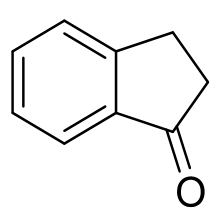
Intramolecular Cyclization to Form Compound : Treatment of 3-phenylpropanoic acid with phosphoric acid (), a dehydrating and acid catalyst, induces an intramolecular Friedel-Crafts acylation. The acylium ion intermediate undergoes electrophilic aromatic substitution onto the adjacent position of the phenyl ring to form the fused bicyclic ketone, 1-indanone:
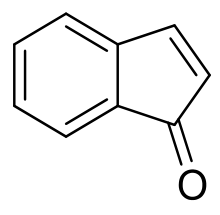
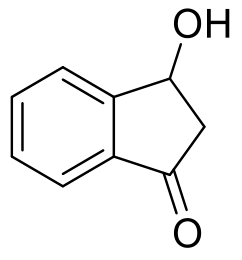
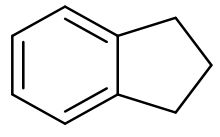
The structure of 1-indanone consists of a benzene ring fused to a five-membered ring containing a carbonyl group () adjacent to the benzene ring. This corresponds to the structure shown in option (A).
Correct Answer: (A)