JEE Challenger
More from Solutions

Degree of Dimerization from Boiling Point Elevation Curves

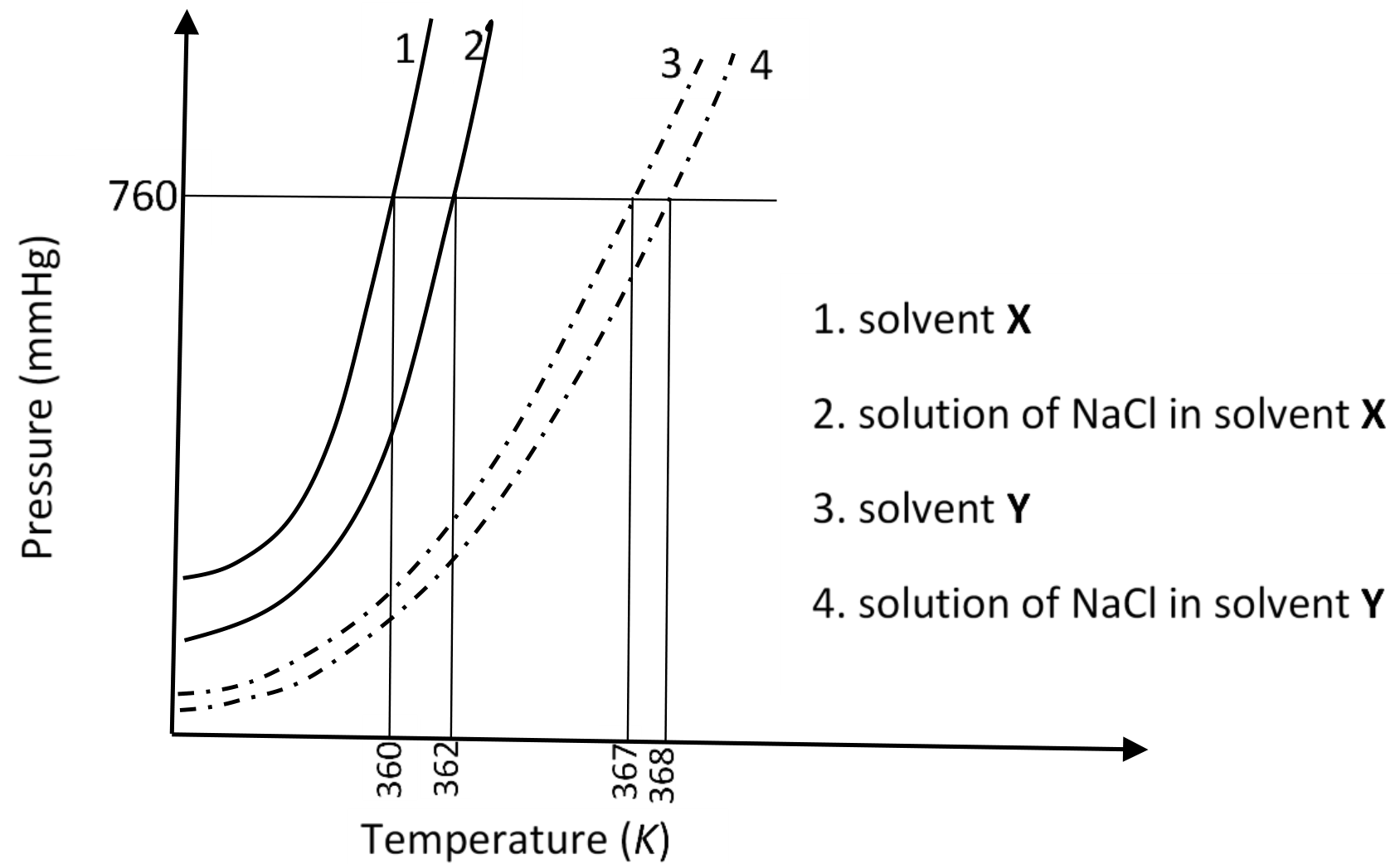
The diagram below illustrates the P−TP - T curves (where PP is vapor pressure and TT is temperature) for two distinct solvents X\mathbf{X} and Y\mathbf{Y}, alongside isomodal solutions of NaCl\text{NaCl} in these two solvents. It is assumed that NaCl\text{NaCl} completely dissociates into ions in both solvents.\n\nWhen an identical number of moles of a non-volatile solute S\mathbf{S} is dissolved in equal masses (in kg\text{kg}) of these two solvents, the elevation of boiling point observed for solvent X\mathbf{X} is three times that observed for solvent Y\mathbf{Y}. The solute S\mathbf{S} undergoes dimerization in both media. Given that the degree of dimerization is 0.70.7 in solvent Y\mathbf{Y}, determine the degree of dimerization of S\mathbf{S} in solvent X\mathbf{X}.

Question Diagram 1
Official Numerical Answer0.05

Step-by-Step Solution

To determine the degree of dimerization of solute S\mathbf{S} in solvent X\mathbf{X}, we proceed through the following steps:

Step 1: Determine the ratio of boiling point elevation constants (Kb,XKb,Y\frac{K_{b,\mathbf{X}}}{K_{b,\mathbf{Y}}})

From the given P−TP - T phase diagram, at atmospheric pressure (P=760 mmHgP = 760\text{ mmHg}):

  • For pure solvent X\mathbf{X} (Curve 1), the normal boiling point is: Tb,X=360 KT_{b,\mathbf{X}} = 360\text{ K}

  • For the NaCl\text{NaCl} solution in solvent X\mathbf{X} (Curve 2), the boiling point is: Tsolution,X=362 KT_{\text{solution},\mathbf{X}} = 362\text{ K}   ⟹  ΔTb,X(NaCl)=362 K−360 K=2 K\implies \Delta T_{b,\mathbf{X}}(\text{NaCl}) = 362\text{ K} - 360\text{ K} = 2\text{ K}

  • For pure solvent Y\mathbf{Y} (Curve 3), the normal boiling point is: Tb,Y=367 KT_{b,\mathbf{Y}} = 367\text{ K}

  • For the NaCl\text{NaCl} solution in solvent Y\mathbf{Y} (Curve 4), the boiling point is: Tsolution,Y=368 KT_{\text{solution},\mathbf{Y}} = 368\text{ K}   ⟹  ΔTb,Y(NaCl)=368 K−367 K=1 K\implies \Delta T_{b,\mathbf{Y}}(\text{NaCl}) = 368\text{ K} - 367\text{ K} = 1\text{ K}

Since the NaCl\text{NaCl} solutions are isomodal, their molality mm is identical. Sodium chloride (NaCl\text{NaCl}) completely dissociates into two ions (Na+\text{Na}^+ and Cl−\text{Cl}^-) in both solvents, so its van 't Hoff factor is iNaCl=2i_{\text{NaCl}} = 2.

The elevation in boiling point is given by: ΔTb=i⋅Kb⋅m\Delta T_b = i \cdot K_b \cdot m

Taking the ratio of the elevations for the two solutions: ΔTb,X(NaCl)ΔTb,Y(NaCl)=iNaCl⋅Kb,X⋅miNaCl⋅Kb,Y⋅m=Kb,XKb,Y\frac{\Delta T_{b,\mathbf{X}}(\text{NaCl})}{\Delta T_{b,\mathbf{Y}}(\text{NaCl})} = \frac{i_{\text{NaCl}} \cdot K_{b,\mathbf{X}} \cdot m}{i_{\text{NaCl}} \cdot K_{b,\mathbf{Y}} \cdot m} = \frac{K_{b,\mathbf{X}}}{K_{b,\mathbf{Y}}}

Substituting the observed elevations: Kb,XKb,Y=2 K1 K=2\frac{K_{b,\mathbf{X}}}{K_{b,\mathbf{Y}}} = \frac{2\text{ K}}{1\text{ K}} = 2


Step 2: Relation involving Solute S\mathbf{S}

When an equal number of moles of solute S\mathbf{S} is added to equal masses of both solvents, the molality m′m' of solute S\mathbf{S} is the same in both solvents.

Solute S\mathbf{S} undergoes dimerization according to the equilibrium: 2S⇌S22\mathbf{S} \rightleftharpoons \mathbf{S}_2

The van 't Hoff factor ii for dimerization with a degree of dimerization β\beta is: i=1−β+β2=1−β2i = 1 - \beta + \frac{\beta}{2} = 1 - \frac{\beta}{2}

For solvent Y\mathbf{Y}, given βY=0.7\beta_{\mathbf{Y}} = 0.7: iY=1−0.72=1−0.35=0.65i_{\mathbf{Y}} = 1 - \frac{0.7}{2} = 1 - 0.35 = 0.65

The elevation in boiling point in each solvent is: ΔTb,X(S)=iX⋅Kb,X⋅m′\Delta T_{b,\mathbf{X}}(\mathbf{S}) = i_{\mathbf{X}} \cdot K_{b,\mathbf{X}} \cdot m' ΔTb,Y(S)=iY⋅Kb,Y⋅m′\Delta T_{b,\mathbf{Y}}(\mathbf{S}) = i_{\mathbf{Y}} \cdot K_{b,\mathbf{Y}} \cdot m'

We are given that: ΔTb,X(S)=3 ΔTb,Y(S)\Delta T_{b,\mathbf{X}}(\mathbf{S}) = 3 \, \Delta T_{b,\mathbf{Y}}(\mathbf{S})

Substitute the expressions for boiling point elevation: iX⋅Kb,X⋅m′=3⋅iY⋅Kb,Y⋅m′i_{\mathbf{X}} \cdot K_{b,\mathbf{X}} \cdot m' = 3 \cdot i_{\mathbf{Y}} \cdot K_{b,\mathbf{Y}} \cdot m'

Dividing both sides by m′⋅Kb,Ym' \cdot K_{b,\mathbf{Y}}: iX(Kb,XKb,Y)=3⋅iYi_{\mathbf{X}} \left(\frac{K_{b,\mathbf{X}}}{K_{b,\mathbf{Y}}}\right) = 3 \cdot i_{\mathbf{Y}}

Substitute Kb,XKb,Y=2\frac{K_{b,\mathbf{X}}}{K_{b,\mathbf{Y}}} = 2 and iY=0.65i_{\mathbf{Y}} = 0.65: iX⋅2=3⋅0.65i_{\mathbf{X}} \cdot 2 = 3 \cdot 0.65 2⋅iX=1.952 \cdot i_{\mathbf{X}} = 1.95 iX=1.952=0.975i_{\mathbf{X}} = \frac{1.95}{2} = 0.975


Step 3: Calculate the degree of dimerization in solvent X\mathbf{X}

Using the relation between iXi_{\mathbf{X}} and the degree of dimerization βX\beta_{\mathbf{X}}: iX=1−βX2i_{\mathbf{X}} = 1 - \frac{\beta_{\mathbf{X}}}{2} 0.975=1−βX20.975 = 1 - \frac{\beta_{\mathbf{X}}}{2} βX2=1−0.975=0.025\frac{\beta_{\mathbf{X}}}{2} = 1 - 0.975 = 0.025 βX=0.05\beta_{\mathbf{X}} = 0.05

The degree of dimerization of S\mathbf{S} in solvent X\mathbf{X} is 0.05.