JEE Challenger
More from Aldehydes, Ketones and Carboxylic Acids

Identification of Carboxylic Acid Derivative Product R

Comprehension Passage

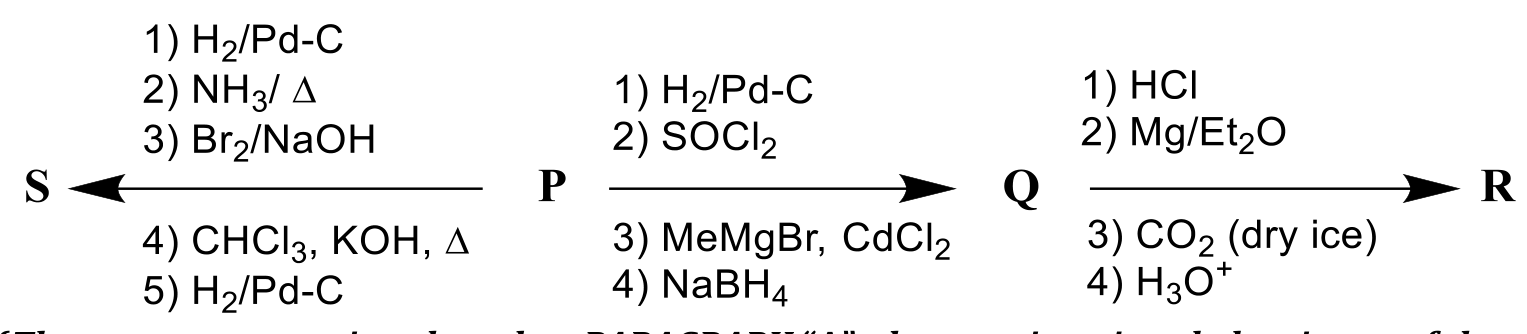
An organic carboxylic acid P\mathbf{P} (C11H12O2\text{C}_{11}\text{H}_{12}\text{O}_2) can be readily oxidized to a dibasic acid which reacts with ethylene glycol to yield the polymer Dacron. Upon ozonolysis, P\mathbf{P} produces an aliphatic ketone as one of the cleavage products. P\mathbf{P} is subjected to the reaction pathways shown below to form compound R\mathbf{R} via intermediate Q\mathbf{Q}, and also reacts via an alternative sequence to afford compound S\mathbf{S}.

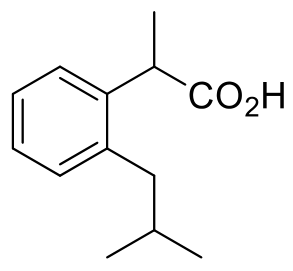
Identify the chemical structure of compound R\mathbf{R}:

Question Diagram 1

Options

A
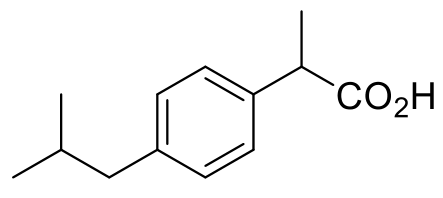
Option A
Correct
B
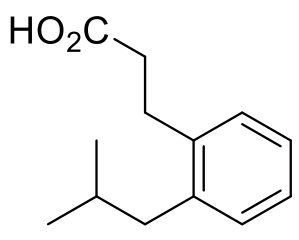
Option B
C
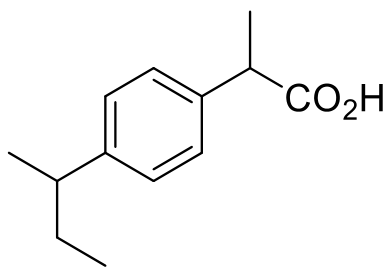
Option C
D
Option D

Step-by-Step Solution

To identify the structure of compound R\mathbf{R}, we analyze each step of the reaction sequence:

1. Deduction of the Structure of Compound P

  1. Formula and Degree of Unsaturation: The molecular formula of P\mathbf{P} is C11H12O2\text{C}_{11}\text{H}_{12}\text{O}_2. Degree of Unsaturation (DU)=11+1−122=6\text{Degree of Unsaturation (DU)} = 11 + 1 - \frac{12}{2} = 6

    • A benzene ring accounts for DU=4\text{DU} = 4.
    • A carboxylic acid group (−COOH-\text{COOH}) accounts for DU=1\text{DU} = 1.
    • The remaining DU=1\text{DU} = 1 corresponds to an aliphatic double bond (C=C\text{C}=\text{C}).
  2. Oxidation to form Dacron Monomer:

    • Dacron (polyethylene terephthalate) is synthesized by polymerizing terephthalic acid (benzene-1,41,4-dicarboxylic acid) with ethylene glycol.
    • Oxidation of P\mathbf{P} yields terephthalic acid, establishing that P\mathbf{P} contains a 1,41,4-disubstituted (para-substituted) benzene ring.
  3. Ozonolysis Product:

    • Subtracting the known fragments from C11H12O2\text{C}_{11}\text{H}_{12}\text{O}_2: C11H12O2−C6H4−COOH=−C4H7\text{C}_{11}\text{H}_{12}\text{O}_2 - \text{C}_6\text{H}_4 - \text{COOH} = -\text{C}_4\text{H}_7
    • Since ozonolysis yields an aliphatic ketone, the side chain must be −CH=C(CH3)2-\text{CH}=\text{C}(\text{CH}_3)_2, which upon oxidative cleavage generates acetone (CH3COCH3\text{CH}_3\text{COCH}_3).
    • Therefore, P\mathbf{P} is 44-(2-methylprop-1-en-1-yl)benzoic acid: P=p-(CH3)2C=CH−C6H4−COOH\mathbf{P} = p\text{-}(\text{CH}_3)_2\text{C}=\text{CH}-\text{C}_6\text{H}_4-\text{COOH}

2. Formation of Intermediate Q

  1. P→H2/Pd-C\mathbf{P} \xrightarrow{\text{H}_2/\text{Pd-C}}: Selective hydrogenation of the aliphatic alkene gives 44-isobutylbenzoic acid: p-(CH3)2CH−CH2−C6H4−COOHp\text{-}(\text{CH}_3)_2\text{CH}-\text{CH}_2-\text{C}_6\text{H}_4-\text{COOH}

  2. →SOCl2\xrightarrow{\text{SOCl}_2}: Conversion of the carboxylic acid to an acyl chloride: p-(CH3)2CH−CH2−C6H4−COClp\text{-}(\text{CH}_3)_2\text{CH}-\text{CH}_2-\text{C}_6\text{H}_4-\text{COCl}

  3. →MeMgBr, CdCl2\xrightarrow{\text{MeMgBr, CdCl}_2}: Reaction of the acyl chloride with dimethylcadmium (Me2Cd\text{Me}_2\text{Cd}, prepared in situ) selectively forms a methyl ketone: p-(CH3)2CH−CH2−C6H4−COCH3p\text{-}(\text{CH}_3)_2\text{CH}-\text{CH}_2-\text{C}_6\text{H}_4-\text{COCH}_3

  4. →NaBH4\xrightarrow{\text{NaBH}_4}: Reduction of the ketone yields the secondary alcohol Q\mathbf{Q}: Q=p-(CH3)2CH−CH2−C6H4−CH(OH)CH3\mathbf{Q} = p\text{-}(\text{CH}_3)_2\text{CH}-\text{CH}_2-\text{C}_6\text{H}_4-\text{CH(OH)CH}_3


3. Formation of Compound R

  1. Q→HCl\mathbf{Q} \xrightarrow{\text{HCl}}: Nucleophilic substitution of the hydroxyl group by chloride: p-(CH3)2CH−CH2−C6H4−CH(Cl)CH3p\text{-}(\text{CH}_3)_2\text{CH}-\text{CH}_2-\text{C}_6\text{H}_4-\text{CH(Cl)CH}_3

  2. →Mg/Et2O\xrightarrow{\text{Mg/Et}_2\text{O}}: Formation of the benzylic Grignard reagent: p-(CH3)2CH−CH2−C6H4−CH(MgCl)CH3p\text{-}(\text{CH}_3)_2\text{CH}-\text{CH}_2-\text{C}_6\text{H}_4-\text{CH(MgCl)CH}_3

  3. →CO2 (dry ice) followed by H3O+\xrightarrow{\text{CO}_2\text{ (dry ice)} \text{ followed by } \text{H}_3\text{O}^+}: Carboxylation followed by acidic workup introduces a carboxylic acid group at the benzylic carbon: R=p-(CH3)2CH−CH2−C6H4−CH(CH3)COOH\mathbf{R} = p\text{-}(\text{CH}_3)_2\text{CH}-\text{CH}_2-\text{C}_6\text{H}_4-\text{CH}(\text{CH}_3)\text{COOH} (This compound is commonly known as Ibuprofen).

Matching this structure with the given options shows that (A) has a para-isobutyl group and a −CH(CH3)COOH-\text{CH}(\text{CH}_3)\text{COOH} substituent.

Correct Option: (A)