Identification of Heat Absorption Steps in Four Step Gas Cycle
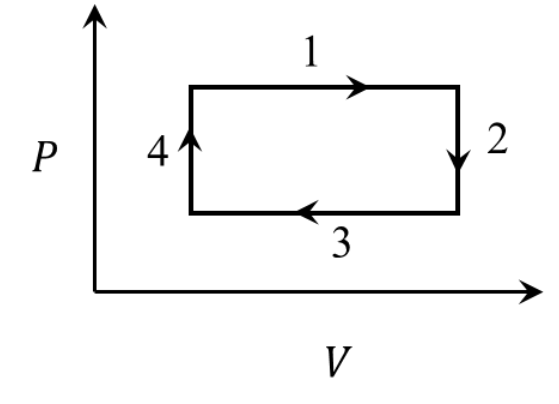
An ideal gas is taken through a four-step cyclic process as shown in the diagram below. Identify the steps in which heat is absorbed by the gas.
Options
A
steps 1 and 2
B
steps 1 and 3
CCorrect
steps 1 and 4
D
steps 2 and 4
Topics & Concepts
Step-by-Step Solution
To determine the steps in which heat is absorbed by the ideal gas, we use the First Law of Thermodynamics: where:
- is the heat added to the system,
- is the change in internal energy,
- is the work done by the gas.
From the ideal gas law , the temperature is directly proportional to the product .
Analysis of Each Step:
-
Step 1: Isobaric Expansion
- Pressure (): Constant at a higher value
- Volume (): Increases (), so the work done is positive: .
- Temperature (): Since is constant and increases, increases ().
- Internal Energy (): .
- Heat ():
- Thus, heat is absorbed in step 1.
-
Step 2: Isochoric Pressure Drop
- Volume (): Constant at ().
- Pressure (): Decreases ().
- Temperature (): Since is constant and decreases, decreases ().
- Internal Energy (): .
- Heat ():
- Thus, heat is released in step 2.
-
Step 3: Isobaric Compression
- Pressure (): Constant at a lower value
- Volume (): Decreases (), so .
- Temperature (): Since is constant and decreases, decreases ().
- Internal Energy (): .
- Heat ():
- Thus, heat is released in step 3.
-
Step 4: Isochoric Pressure Increase
- Volume (): Constant at ().
- Pressure (): Increases ().
- Temperature (): Since is constant and increases, increases ().
- Internal Energy (): .
- Heat ():
- Thus, heat is absorbed in step 4.
Conclusion:
Heat is absorbed by the gas in steps 1 and 4.
Correct Option: (C)