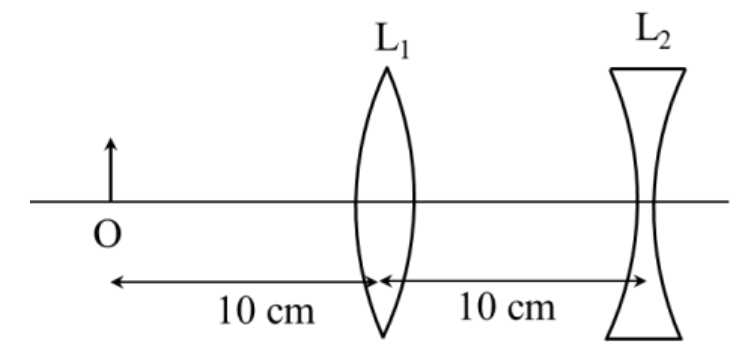
To find the total magnification of the combination of lenses, we first determine the focal length of each lens using the Lens Maker's Formula:
f1=(μ−1)(R11−R21)
-
For the convex lens (L1):
Here, R1=+20 cm and R2=−20 cm with μ=1.5.
f11=(1.5−1)(201−−201)=0.5×202=201 cm−1
f1=+20 cm
-
For the concave lens (L2):
Here, R1=−20 cm and R2=+20 cm with μ=1.5.
f21=(1.5−1)(−201−201)=0.5×(−202)=−201 cm−1
f2=−20 cm
-
Refraction at Lens L1:
The object is placed at u1=−10 cm in front of L1.
Using the thin lens formula:
v11−u11=f11
v11−−101=201
v11=201−101=−201 cm−1
v1=−20 cm
The magnification produced by L1 is:
m1=u1v1=−10−20=+2
-
Refraction at Lens L2:
The image I1 formed by L1 acts as a virtual object for L2.
Since I1 is formed 20 cm to the left of L1 and L2 is located 10 cm behind L1, the position of this image relative to L2 is:
u2=−(20+10)=−30 cm
Using the thin lens formula for L2:
v21−u21=f21
v21−−301=−201
v21=−201−301=−605=−121 cm−1
v2=−12 cm
The magnification produced by L2 is:
m2=u2v2=−30−12=+0.4
- Total Magnification of the Combination:
The total magnification m of the system is the product of the individual magnifications:
m=m1×m2=2×0.4=0.8
Thus, the overall magnification produced by the combination of lenses is 0.8.
Correct Answer: (B) 0.8