JEE Challenger
More from Hydrocarbons

Identification of Cleavage Products J K and L

Comprehension Passage

Paragraph for Question Nos. 58 to 60

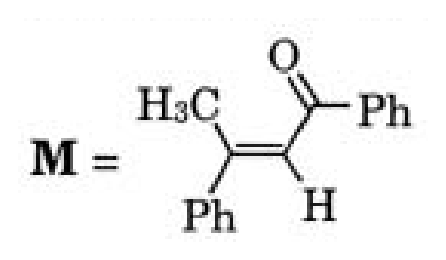
A tertiary alcohol H\mathbf{H} upon acid catalysed dehydration gives a product I\mathbf{I}. Ozonolysis of I\mathbf{I} leads to compounds J\mathbf{J} and K\mathbf{K}. Compound J\mathbf{J} upon reaction with KOH\mathrm{KOH} gives benzyl alcohol and a compound L\mathbf{L}, whereas K\mathbf{K} on reaction with KOH\mathrm{KOH} gives only M\mathbf{M}.

Passage Diagram 0

The structures of compounds J\mathbf{J}, K\mathbf{K} and L\mathbf{L}, respectively, are

Options

A

PhCOCH3\text{PhCOCH}_3, PhCH2COCH3\text{PhCH}_2\text{COCH}_3 and PhCH2COO−K+\text{PhCH}_2\text{COO}^-\text{K}^+

B

PhCHO\text{PhCHO}, PhCH2CHO\text{PhCH}_2\text{CHO} and PhCOO−K+\text{PhCOO}^-\text{K}^+

C

PhCOCH3\text{PhCOCH}_3, PhCH2CHO\text{PhCH}_2\text{CHO} and CH3COO−K+\text{CH}_3\text{COO}^-\text{K}^+

D

PhCHO\text{PhCHO}, PhCOCH3\text{PhCOCH}_3 and PhCOO−K+\text{PhCOO}^-\text{K}^+

Correct

Step-by-Step Solution

Based on the reaction sequence in the passage, compound I\mathbf{I} is (E)(E)-1,2-diphenylprop-1-ene:

PhCH=C(CH3)Ph\text{PhCH}=\text{C}(\text{CH}_3)\text{Ph}

  1. Ozonolysis / Cleavage of Alkene I\mathbf{I}:
    Reductive cleavage (such as ozonolysis in the presence of Zn/H2O\text{Zn}/\text{H}_2\text{O}) of the double bond in I\mathbf{I} yields benzaldehyde and acetophenone:
    PhCH=C(CH3)Ph→O3/Zn,H2OPhCHO (J)+PhCOCH3 (K)\text{PhCH}=\text{C}(\text{CH}_3)\text{Ph} \xrightarrow{\text{O}_3 / \text{Zn}, \text{H}_2\text{O}} \text{PhCHO} \, (\mathbf{J}) + \text{PhCOCH}_3 \, (\mathbf{K})

  2. Formation of Compound L\mathbf{L}:

    • Benzaldehyde (PhCHO\text{PhCHO}) on treatment with concentrated aqueous KOH\text{KOH} undergoes the Cannizzaro reaction:
      2 PhCHO→KOHPhCOO−K+ (L)+PhCH2OH2\,\text{PhCHO} \xrightarrow{\text{KOH}} \text{PhCOO}^-\text{K}^+ \, (\mathbf{L}) + \text{PhCH}_2\text{OH}
    • Alternatively, acetophenone (PhCOCH3\text{PhCOCH}_3) undergoes the haloform reaction with I2/KOH\text{I}_2/\text{KOH} to yield potassium benzoate (PhCOO−K+\text{PhCOO}^-\text{K}^+) along with iodoform (CHI3\text{CHI}_3).

Thus, the structures of compounds J\mathbf{J}, K\mathbf{K}, and L\mathbf{L} are:

  • J=PhCHO\mathbf{J} = \text{PhCHO}
  • K=PhCOCH3\mathbf{K} = \text{PhCOCH}_3
  • L=PhCOO−K+\mathbf{L} = \text{PhCOO}^-\text{K}^+

Therefore, the correct option is D.