Identification of Compound S from Carboxylic Acid P Reaction Sequence
Comprehension Passage
PARAGRAPH "A"
An organic acid P (C11H12O2) can easily be oxidized to a dibasic acid which reacts with ethylene glycol to form the polymer dacron. Upon ozonolysis, P yields an aliphatic ketone as one of the products. P undergoes the following reaction sequences to furnish R via Q. The compound P also undergoes another sequence of reactions to produce S.
To determine the structure of compound S, let us analyze the given information step-by-step:
1. Determination of the Structure of Compound P (C11H12O2)
Degree of Unsaturation (DU):DU=11+1−212=6
Oxidation product:
Compound P is oxidized easily to a dibasic acid that condenses with ethylene glycol to give Dacron (poly(ethylene terephthalate)). Therefore, the dibasic acid is terephthalic acid (benzene-1,4-dicarboxylic acid), indicating that P is a 1,4-disubstituted (para-substituted) benzene derivative.
Ozonolysis product:
Upon ozonolysis, P yields an aliphatic ketone, which means the side chain has a terminal branched alkene unit, −CH=C(CH3)2, yielding acetone (CH3COCH3).
Structure of P:
Combining the carboxylic acid group (−COOH), the benzene ring (−C6H4−), and the alkene group (−CH=C(CH3)2):
P=HOOC−C6H4−CH=C(CH3)2(4-(2-methylprop-1-en-1-yl)benzoic acid)
2. Reaction Sequence to Form Compound S
The conversion of P to S proceeds through the following steps:
Step 1: Catalytic Hydrogenation (H2/Pd-C)
The aliphatic C=C double bond is reduced to give 4-isobutylbenzoic acid:
HOOC−C6H4−CH=C(CH3)2H2/Pd-CHOOC−C6H4−CH2−CH(CH3)2
Step 2: Amidation (NH3,Δ)
The carboxylic acid group is converted into a primary amide:
HOOC−C6H4−CH2−CH(CH3)2NH3,ΔH2NOC−C6H4−CH2−CH(CH3)2
Step 3: Hoffmann Bromamide Degradation (Br2/NaOH)
The amide is degraded to a primary aromatic amine:
H2NOC−C6H4−CH2−CH(CH3)2Br2/NaOHH2N−C6H4−CH2−CH(CH3)2(4-isobutylaniline)
Step 4: Carbylamine Reaction (CHCl3,KOH,Δ)
The primary amine reacts to form an isocyanide (isonitrile):
H2N−C6H4−CH2−CH(CH3)2CHCl3,KOH,ΔC≡N−C6H4−CH2−CH(CH3)2
Step 5: Reduction of Isocyanide (H2/Pd-C)
Catalytic hydrogenation reduces the isocyanide group (−N≡C) to a secondary methylamino group (−NH−CH3):
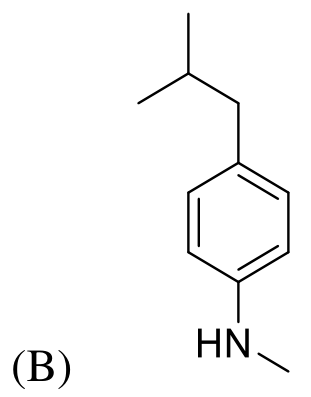
C≡N−C6H4−CH2−CH(CH3)2H2/Pd-CCH3−NH−C6H4−CH2−CH(CH3)2
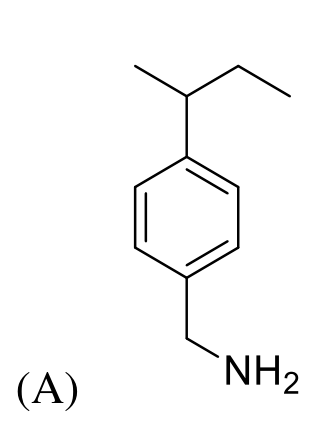
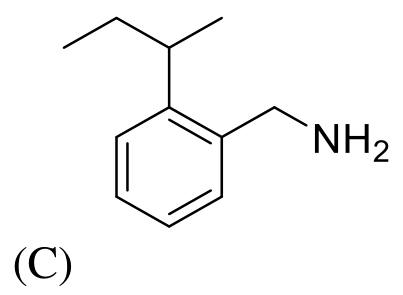
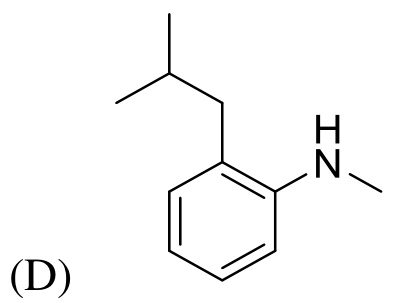
Thus, compound S is N-methyl-4-isobutylaniline, which corresponds to structure (B).