Identification of Carbonyl Compound P in Multistep Synthesis
Comprehension Passage
Paragraph for Question Nos. 16 to 18
A carbonyl compound , which gives positive iodoform test, undergoes reaction with followed by dehydration to give an olefin . Ozonolysis of leads to a dicarbonyl compound , which undergoes intramolecular aldol reaction to give predominantly .
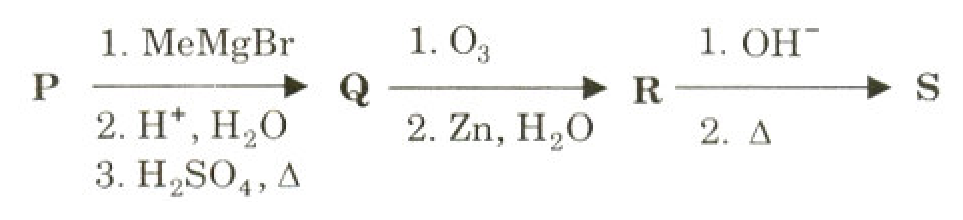
The structure of the carbonyl compound is
Options
A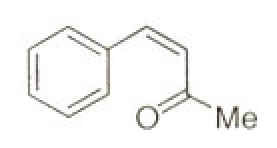
B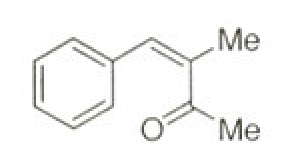 Correct
C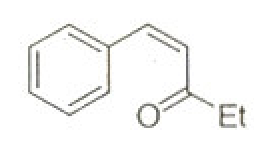
D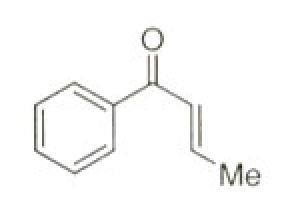
Step-by-Step Solution
To determine the structure of the carbonyl compound , we analyze the reaction steps:
-
Iodoform Test:
A positive iodoform test indicates the presence of a methyl carbonyl group, (or a group).- In option (A): (contains )
- In option (B): (contains )
- In option (C): (does not contain , negative test)
- In option (D): (does not contain , negative test)
Thus, options (C) and (D) are eliminated.
-
Reaction with and Dehydration:
Starting with compound from option (B), :- Nucleophilic addition of to the carbonyl carbon gives a tertiary alcohol:
- Upon heating with acid (), protonation of the hydroxyl group followed by loss of water yields a resonance-stabilized allylic carbocation:
- The electrophilic carbocation undergoes an intramolecular Friedel-Crafts alkylation with the aromatic ring to form a five-membered indane core:
The ortho-position of the benzene ring attacks the tertiary carbocation center, followed by deprotonation to yield an indene derivative :
which contains a gem-dimethyl group () and a methyl-substituted double bond.
- Nucleophilic addition of to the carbonyl carbon gives a tertiary alcohol:
-
Ozonolysis to :
- Reductive ozonolysis () of the double bond in cleaves the bond, giving the dicarbonyl compound :
This is consistent with the subsequent intramolecular aldol condensation leading to .
- Reductive ozonolysis () of the double bond in cleaves the bond, giving the dicarbonyl compound :
Therefore, the structure of carbonyl compound corresponds to (B).