Determination of Olefin Q and Dicarbonyl Compound R
Paragraph for Question Nos. 16 to 18
A carbonyl compound , which gives positive iodoform test, undergoes reaction with followed by dehydration to give an olefin . Ozonolysis of leads to a dicarbonyl compound , which undergoes intramolecular aldol reaction to give predominantly .
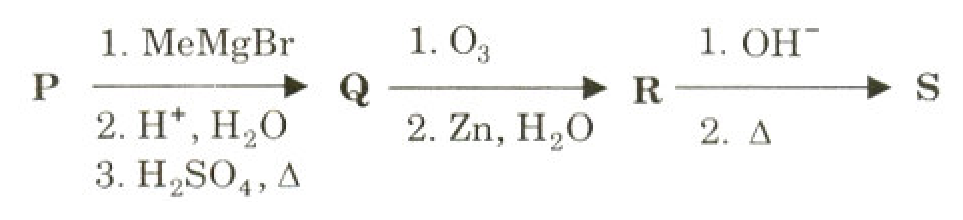
The structures of the products and , respectively, are
Options
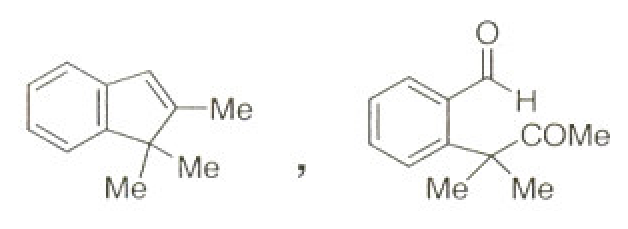
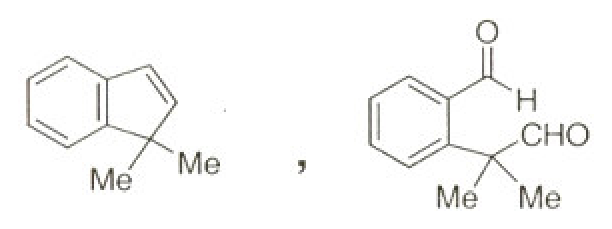
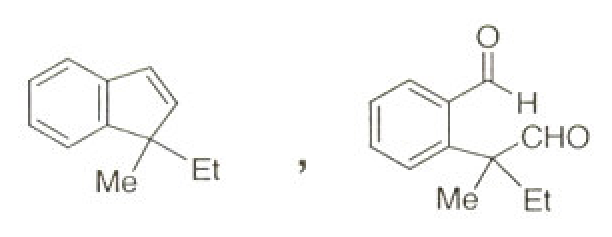
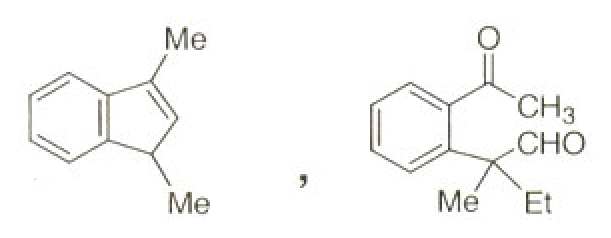
Step-by-Step Solution
To determine the structures of and , let us trace the reaction sequence step by step:
-
Analysis of Compound :
Compound gives a positive iodoform test, confirming the presence of a methyl ketone group (). It has the structure 4-phenylpent-3-en-2-one:
-
Reaction to form :
- Step 1 & 2 (Grignard Reaction): reacts with at the carbonyl carbon, followed by hydrolysis, to yield the tertiary alcohol:
- Step 3 (Acid-catalyzed cyclization and dehydration): In the presence of concentrated with heating, protonation of the alcohol followed by loss of water generates a stable tertiary carbocation, or protonation of the alkene leads to intramolecular electrophilic aromatic attack (Friedel-Crafts alkylation) onto the benzene ring followed by dehydration to form a bicyclic indene derivative:
- The product is 1,1,2-trimethyl-1-indene, where the five-membered ring fused to the benzene ring contains a gem-dimethyl group () and a double bond substituted with a methyl group ().
- Step 1 & 2 (Grignard Reaction): reacts with at the carbonyl carbon, followed by hydrolysis, to yield the tertiary alcohol:
-
Ozonolysis of to form :
Reductive ozonolysis ( followed by ) selectively cleaves the endocyclic double bond of the indene ring:- The olefinic carbon bonded to the aromatic ring () is cleaved to form an aromatic aldehyde group ().
- The other olefinic carbon bearing the methyl substituent () is cleaved to form an acetyl group ().
- The group remains connected between the benzene ring and the acetyl group.
Thus, the resulting dicarbonyl compound is an ortho-disubstituted benzene derivative:
-
Intramolecular Aldol Condensation to form :
Under basic conditions (), enolate generation at the methyl group of the moiety followed by nucleophilic attack on the aromatic group results in the formation of a stable, conjugated six-membered ring system (a tetralone derivative), consistent with predominantly forming .
Therefore, the structures of and correspond precisely to Option (A).