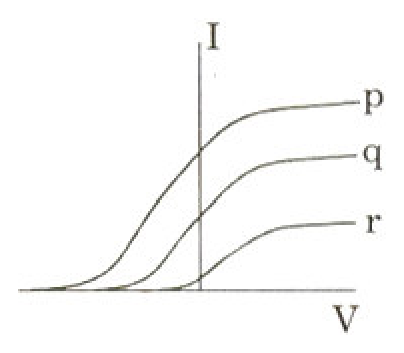
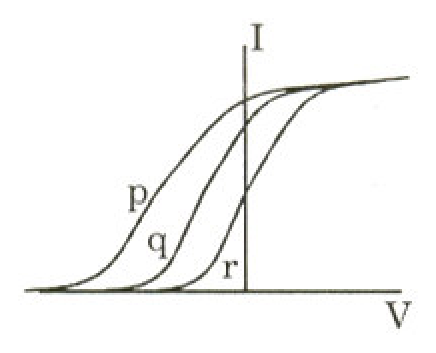
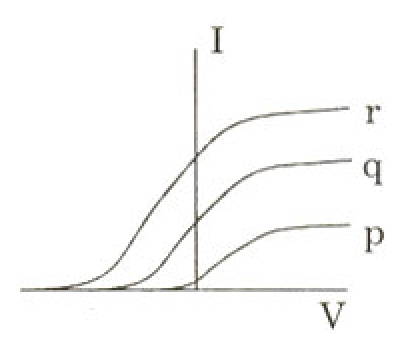
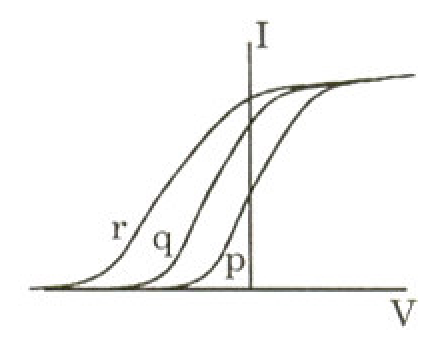
To determine the correct I-V characteristic curves for the three plates, we first find the energy of the incident photons of each wavelength using E=λhc, with hc=1240 eV nm:
-
For λ1=550 nm:
E1=5501240 eV≈2.25 eV
-
For λ2=450 nm:
E2=4501240 eV≈2.76 eV
-
For λ3=350 nm:
E3=3501240 eV≈3.54 eV
The work functions of the three metal plates are:
- ϕp=2.0 eV
- ϕq=2.5 eV
- ϕr=3.0 eV
Condition for Photoelectric Emission:
Photoelectric emission occurs only when the incident photon energy is greater than the work function of the metal (E>ϕ):
-
For plate p (ϕp=2.0 eV):
- E1=2.25 eV>2.0 eV (causes emission)
- E2=2.76 eV>2.0 eV (causes emission)
- E3=3.54 eV>2.0 eV (causes emission)
All three wavelengths contribute to the photocurrent.
-
For plate q (ϕq=2.5 eV):
- E1=2.25 eV<2.5 eV (no emission)
- E2=2.76 eV>2.5 eV (causes emission)
- E3=3.54 eV>2.5 eV (causes emission)
Two wavelengths (λ2 and λ3) contribute to the photocurrent.
-
For plate r (ϕr=3.0 eV):
- E1=2.25 eV<3.0 eV (no emission)
- E2=2.76 eV<3.0 eV (no emission)
- E3=3.54 eV>3.0 eV (causes emission)
Only one wavelength (λ3) contributes to the photocurrent.
Saturation Current (Isat):
The saturation current is proportional to the number of photoelectrons emitted per second. Since each wavelength beam has equal intensity:
Isat,p>Isat,q>Isat,r
Stopping Potential (V0):
The stopping potential is determined by the maximum kinetic energy of the emitted photoelectrons, which is produced by the highest energy photon (E3=3.54 eV):
eV0=Kmax=E3−ϕ
- For plate p:
eV0,p=3.54 eV−2.0 eV=1.54 eV⟹V0,p=1.54 V
- For plate q:
eV0,q=3.54 eV−2.5 eV=1.04 eV⟹V0,q=1.04 V
- For plate r:
eV0,r=3.54 eV−3.0 eV=0.54 eV⟹V0,r=0.54 V
Thus, in terms of stopping potential magnitude:
V0,p>V0,q>V0,r
On the negative potential axis, the current becomes zero at −V0. Therefore, plate p cuts off furthest to the left, followed by q, and plate r cuts off closest to the origin.
Combining both results:
- Stopping potential: ∣−V0,p∣>∣−V0,q∣>∣−V0,r∣
- Saturation current: Ip>Iq>Ir
This corresponds to graph (A).