Formation of Mesitylene Through Various Organic Synthesis Routes
Identify the chemical reaction(s) that result in the synthesis of 1,3,5-trimethylbenzene:
Options
A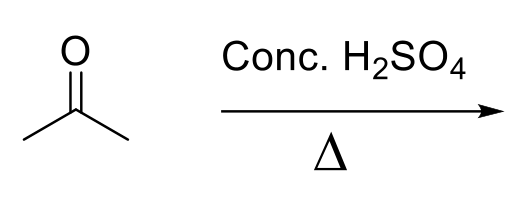 Correct
B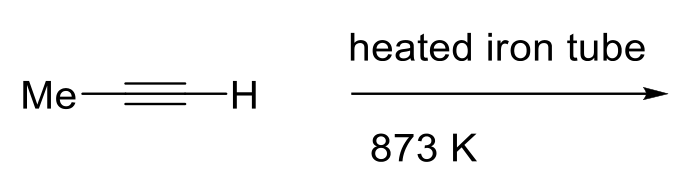 Correct
C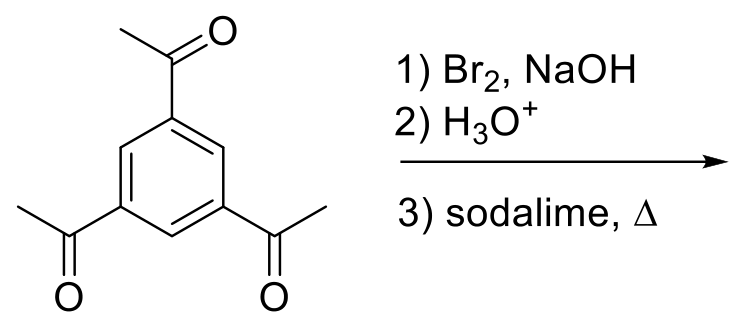
D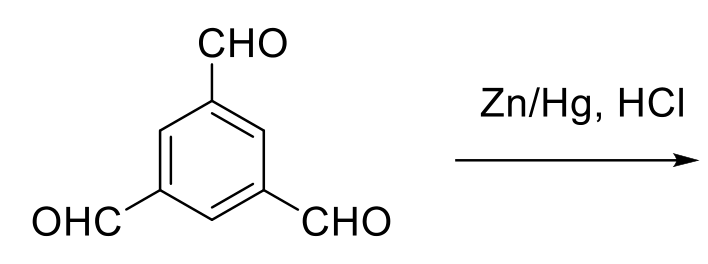 Correct
Step-by-Step Solution
To determine which reaction(s) lead to the formation of -trimethylbenzene (commonly known as mesitylene), let us analyze each option step-by-step:
-
Option (A):
- Reaction: Acetone () treated with concentrated under heating ().
- Mechanism: Concentrated acts as a dehydrating and acid-catalyzing agent. Three molecules of acetone undergo an acid-catalyzed intermolecular aldol condensation followed by dehydration:
- Result: This is a classic and well-known synthetic method for preparing -trimethylbenzene (mesitylene). Hence, Option (A) is correct.
-
Option (B):
- Reaction: Propyne () passed through a heated iron tube at .
- Mechanism: Cyclic trimerization of terminal alkynes occurs at high temperatures over transition-metal catalysts (such as an iron or copper tube). The cyclic trimerization of propyne yields a mixture of regioisomers:
- Result: Since -trimethylbenzene is formed as one of the products, Option (B) is correct.
-
Option (C):
- Reaction: -triacetylbenzene subjected to:
- (haloform reaction)
- (acidification)
- Sodalime (), (decarboxylation)
- Mechanism:
- In steps (1) and (2), the methyl ketone groups () undergo the haloform reaction to form carboxylic acid groups (), giving benzene--tricarboxylic acid (trimesic acid):
- In step (3), heating trimesic acid with sodalime causes complete decarboxylation of all three carboxylic acid groups:
- Result: The final product obtained is benzene, not -trimethylbenzene. Hence, Option (C) is incorrect.
- Reaction: -triacetylbenzene subjected to:
-
Option (D):
- Reaction: Benzene--tricarbaldehyde treated with and concentrated (Clemmensen reduction).
- Mechanism: The Clemmensen reduction selectively reduces carbonyl groups of aldehydes and ketones to methylene/methyl groups ():
- Result: This directly produces -trimethylbenzene. Hence, Option (D) is correct.
Therefore, the reactions that lead to the formation of -trimethylbenzene are (A), (B), and (D).