JEE Challenger
More from Thermodynamics

Thermodynamic State Functions for Ideal Gas in Reversible Cyclic Process

A reversible cyclic process undergone by an ideal gas is depicted below. Here, PP, VV, and TT represent pressure, volume, and temperature, respectively. The thermodynamic variables qq, ww, HH, and UU denote heat, work, enthalpy, and internal energy, respectively.

The correct option(s) is (are)
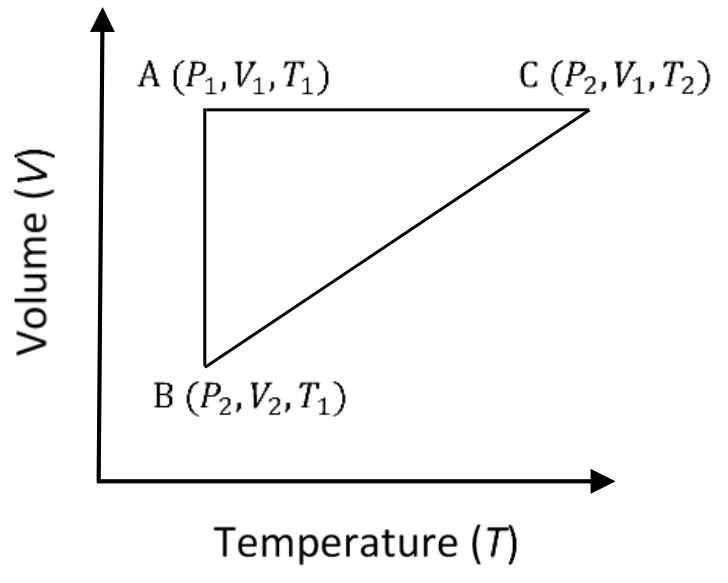
Question Diagram 1

Options

A

qAC=ΔUBCq_{AC} = \Delta U_{BC} and wAB=P2(V2−V1)w_{AB} = P_2(V_2 - V_1)

B

wBC=P2(V2−V1)w_{BC} = P_2(V_2 - V_1) and qBC=ΔHACq_{BC} = \Delta H_{AC}

Correct
C

ΔHCA<ΔUCA\Delta H_{CA} < \Delta U_{CA} and qAC=ΔUBCq_{AC} = \Delta U_{BC}

Correct
D

qBC=ΔHACq_{BC} = \Delta H_{AC} and ΔHCA>ΔUCA\Delta H_{CA} > \Delta U_{CA}

Step-by-Step Solution

To determine the correct option(s), we analyze the thermodynamic properties for each step of the reversible cyclic process undergone by the ideal gas.

1. Identification of the Processes

From the given V–TV\text{--}T diagram:

  • Process A→B\text{A} \to \text{B}: The temperature remains constant at T=T1T = T_1, while the volume decreases from V1V_1 to V2V_2. This is a reversible isothermal compression.
  • Process A→C\text{A} \to \text{C}: The volume remains constant at V=V1V = V_1, while the temperature increases from T1T_1 to T2T_2. This is a reversible isochoric heating.
  • Process B→C\text{B} \to \text{C}: Since the state B\text{B} is (P2,V2,T1)(P_2, V_2, T_1) and state C\text{C} is (P2,V1,T2)(P_2, V_1, T_2), the pressure is constant at P=P2P = P_2 (as V∝TV \propto T). This is a reversible isobaric expansion.

2. Evaluation of Thermodynamic Quantities

(i) Process A→C\text{A} \to \text{C} (Isochoric):

Since the volume is constant (ΔV=0\Delta V = 0): wAC=0w_{AC} = 0 From the First Law of Thermodynamics: qAC=ΔUAC=nCv(T2−T1)q_{AC} = \Delta U_{AC} = n C_v (T_2 - T_1) The enthalpy change for this step is: ΔHAC=nCp(T2−T1)\Delta H_{AC} = n C_p (T_2 - T_1)

(ii) Process B→C\text{B} \to \text{C} (Isobaric at pressure P2P_2):

The internal energy change depends only on the initial and final temperatures: ΔUBC=nCv(T2−T1)\Delta U_{BC} = n C_v (T_2 - T_1) Comparing with qACq_{AC}: qAC=ΔUBCq_{AC} = \Delta U_{BC}

The work done on/by the gas (using the standard IUPAC chemistry convention w=−∫PextdVw = -\int P_{\text{ext}} dV): wBC=−∫V2V1P2 dV=−P2(V1−V2)=P2(V2−V1)w_{BC} = -\int_{V_2}^{V_1} P_2 \, dV = -P_2(V_1 - V_2) = P_2(V_2 - V_1)

The heat absorbed at constant pressure is equal to the enthalpy change: qBC=ΔHBC=nCp(T2−T1)q_{BC} = \Delta H_{BC} = n C_p (T_2 - T_1) Since ΔHAC=nCp(T2−T1)\Delta H_{AC} = n C_p (T_2 - T_1), we have: qBC=ΔHACq_{BC} = \Delta H_{AC}

(iii) Process A→B\text{A} \to \text{B} (Isothermal):

For a reversible isothermal process of an ideal gas: wAB=−∫V1V2P dV=−nRT1ln⁡(V2V1)≠P2(V2−V1)w_{AB} = -\int_{V_1}^{V_2} P \, dV = -n R T_1 \ln\left(\frac{V_2}{V_1}\right) \neq P_2(V_2 - V_1)

(iv) Process C→A\text{C} \to \text{A}:

Here, the temperature decreases from T2T_2 to T1T_1 (ΔT=T1−T2<0\Delta T = T_1 - T_2 < 0). ΔHCA=nCp(T1−T2)\Delta H_{CA} = n C_p (T_1 - T_2) ΔUCA=nCv(T1−T2)\Delta U_{CA} = n C_v (T_1 - T_2) For an ideal gas, Cp>Cv>0C_p > C_v > 0. Since (T1−T2)(T_1 - T_2) is negative: nCp(T1−T2)<nCv(T1−T2)  ⟹  ΔHCA<ΔUCAn C_p (T_1 - T_2) < n C_v (T_1 - T_2) \implies \Delta H_{CA} < \Delta U_{CA}


3. Analysis of Options

  • Option (A): qAC=ΔUBCq_{AC} = \Delta U_{BC} is correct, but wAB=P2(V2−V1)w_{AB} = P_2(V_2 - V_1) is incorrect.
  • Option (B): wBC=P2(V2−V1)w_{BC} = P_2(V_2 - V_1) and qBC=ΔHACq_{BC} = \Delta H_{AC} are both correct.
  • Option (C): ΔHCA<ΔUCA\Delta H_{CA} < \Delta U_{CA} and qAC=ΔUBCq_{AC} = \Delta U_{BC} are both correct.
  • Option (D): qBC=ΔHACq_{BC} = \Delta H_{AC} is correct, but ΔHCA>ΔUCA\Delta H_{CA} > \Delta U_{CA} is incorrect.

Thus, the correct options are B and C.