Stereochemical Outcome in Sequential Nucleophilic Substitution Reactions
In the reaction sequence shown below, identify the correct structure(s) of compound :
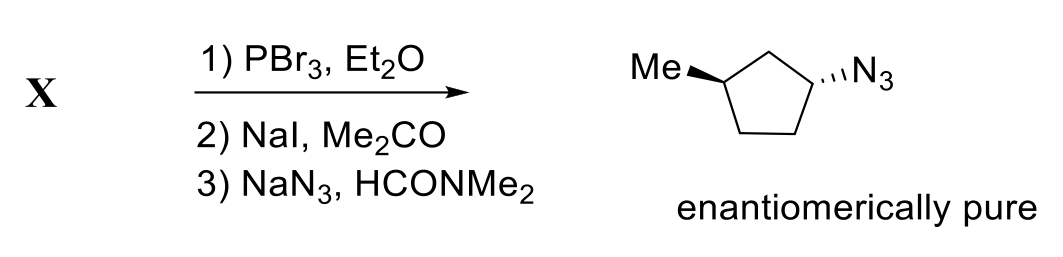
Options
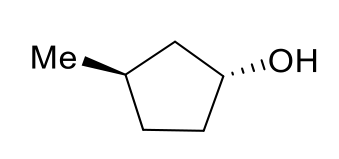
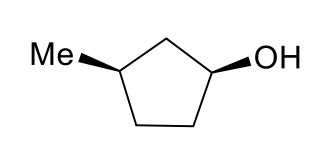
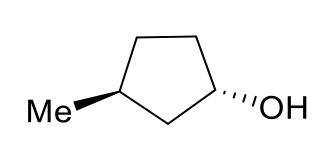
Step-by-Step Solution
To determine the correct structure of compound , let us analyze the stereochemical outcome of each step in the reaction sequence.
1. Analysis of the Reaction Mechanism and Stereochemistry
The reaction sequence consists of three consecutive nucleophilic substitution steps at the stereocenter bearing the hydroxyl group:
-
Step 1: Reaction with in The reaction of a secondary alcohol with phosphorus tribromide proceeds via the initial formation of a dibromophosphite intermediate (), followed by backside attack by a bromide ion () in an fashion:
-
Step 2: Reaction with in acetone (Finkelstein Reaction) The alkyl bromide reacts with iodide ion () in acetone via an displacement:
-
Step 3: Reaction with in () The alkyl iodide undergoes nucleophilic displacement by azide ion () in a polar aprotic solvent () via an pathway:
Because three sequential substitutions occur at the same carbon center, the overall stereochemical outcome is a net inversion of configuration at this stereocenter:
The chiral carbon bearing the methyl group () does not participate in any of the reaction steps, so its absolute configuration remains completely retained.
2. Determination of Absolute Configuration of the Product
The product shown is an enantiomerically pure 1,3-disubstituted cyclopentane:
- The methyl group () is attached to with a solid wedge bond.
- The azide group () is attached to with a dashed bond.
Assigning the Cahn-Ingold-Prelog configurations:
-
At (bearing ):
- Priority 1: ()
- Priority 2: ()
- Priority 3:
- Priority 4: (on a dash, pointing away from the viewer)
Tracing the path from Priority yields a clockwise direction. With the lowest priority group () pointing away, the configuration at is .
-
At (bearing ):
- Priority 1: (on a dash)
- Priority 2: ()
- Priority 3: ()
- Priority 4: (on a wedge, pointing towards the viewer)
Tracing the path from Priority on the plane yields a counter-clockwise direction. Since the lowest priority group () is on a wedge, the configuration reverses to .
Thus, the product is -1-azido-3-methylcyclopentane (trans isomer).
3. Absolute Configuration Required for Compound
- At : Configuration is retained
- At : Configuration undergoes net inversion
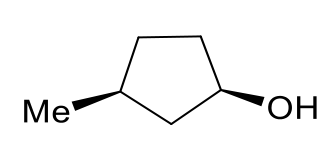
Therefore, compound must have the absolute configuration , which corresponds to cis-3-methylcyclopentanol.
4. Evaluation of the Given Structures
-
(A): Features a trans relationship (methyl on wedge, hydroxyl on dash), which corresponds to the diastereomer. Under net inversion at , this would yield a cis product, which does not match the product.
-
(B): Features a cis relationship where the five-membered ring has the single bridging methylene carbon () at the top, with both the group and the group on solid wedges.
- At : is on a wedge, is on a dash
- At : is on a wedge, is on a dash
This is precisely the required enantiomer.
-
(C): Features a trans relationship (one wedge, one dash) in an inverted ring orientation, representing the isomer.
-
(D): Features the ring drawn with the single bridging carbon at the bottom and both substituents on wedges, which represents the enantiomer of (B), having the configuration.
Therefore, the only correct structure of is (B).