Find Angle Beta for Minimum Deviation in Consecutive Triangular Prisms
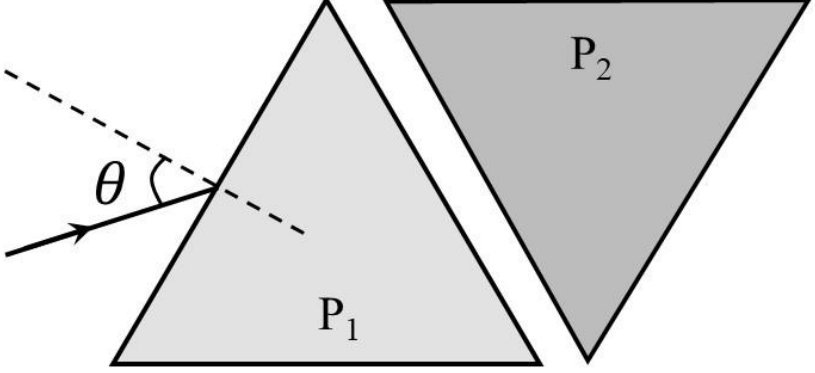
Two equilateral-triangular prisms and are kept with their sides parallel to each other, in vacuum, as shown in the figure. A light ray enters prism at an angle of incidence such that the outgoing ray undergoes minimum deviation in prism . If the respective refractive indices of and are and , then , where the value of is ________.
Topics & Concepts
Step-by-Step Solution
To find the value of , we trace the path of the light ray through the two prisms and .
Step 1: Minimum Deviation in Prism
Prism is an equilateral triangle, so its refracting angle is . Its refractive index is given as .
For a prism undergoing minimum deviation, the angle of refraction at the first surface is related to the apex angle by:
Applying Snell's law at the first surface of (transition from vacuum to ):
Thus, the angle of incidence on prism is:
Step 2: Emergence Angle from Prism
Since the sides of prisms and are parallel to each other, the emergent face (right face) of is parallel to the incident face (left face) of .
Because the light ray travels through vacuum between two parallel surfaces, the angle of emergence from is equal to the angle of incidence on :
Step 3: Refraction inside Prism
Prism is also equilateral, so . Its refractive index is .
Applying Snell's law at the second face (emergent face) of :
Thus, the internal angle of refraction at the second face of is:
Inside prism , the angles of refraction satisfy:
Step 4: Angle of Incidence on Prism
Applying Snell's law at the first face of :
Comparing this with the given expression:
We get: