JEE Challenger
More from Electric Charges and Fields

Electric Flux Through Curved Surface of Cylinder

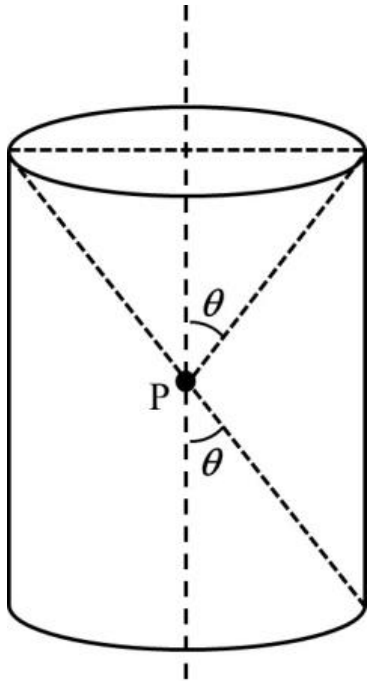
A charge is kept at the central point P of a cylindrical region. The two edges subtend a half-angle θ\theta at P, as shown in the figure. When θ=30\theta = 30^\circ, then the electric flux through the curved surface of the cylinder is Φ\Phi. If θ=60\theta = 60^\circ, then the electric flux through the curved surface becomes Φ/n\Phi/\sqrt{n}, where the value of nn is _____.

Question Diagram 1
Official Numerical Answer3

Step-by-Step Solution

To find the electric flux through the curved surface of the cylinder, we can apply Gauss's Law and the concept of solid angles.

1. Total Electric Flux

Let qq be the point charge located at the central point PP of the cylinder. According to Gauss's Law, the total electric flux emanating from the charge through any closed surface enclosing it is: Φtotal=qε0\Phi_{\text{total}} = \frac{q}{\varepsilon_0}

2. Flux Through the Flat Circular Faces

The solid angle Ω\Omega subtended by a circular disk at a point on its axis, which subtends a half-angle θ\theta at that point, is given by: Ω=2π(1cosθ)\Omega = 2\pi (1 - \cos\theta)

The electric flux Φtop\Phi_{\text{top}} passing through the top flat circular face of the cylinder is proportional to this solid angle: Φtop=q4πε0Ω=q4πε02π(1cosθ)=q2ε0(1cosθ)\Phi_{\text{top}} = \frac{q}{4\pi\varepsilon_0} \cdot \Omega = \frac{q}{4\pi\varepsilon_0} \cdot 2\pi(1 - \cos\theta) = \frac{q}{2\varepsilon_0}(1 - \cos\theta)

By symmetry, the electric flux passing through the bottom flat circular face is identical: Φbottom=q2ε0(1cosθ)\Phi_{\text{bottom}} = \frac{q}{2\varepsilon_0}(1 - \cos\theta)

3. Flux Through the Curved Surface

The total flux through the closed cylinder is the sum of the fluxes through the top face, bottom face, and the curved surface: Φcurved+Φtop+Φbottom=Φtotal\Phi_{\text{curved}} + \Phi_{\text{top}} + \Phi_{\text{bottom}} = \Phi_{\text{total}}

Substituting the values into the equation: Φcurved+q2ε0(1cosθ)+q2ε0(1cosθ)=qε0\Phi_{\text{curved}} + \frac{q}{2\varepsilon_0}(1 - \cos\theta) + \frac{q}{2\varepsilon_0}(1 - \cos\theta) = \frac{q}{\varepsilon_0}

Φcurved+qε0(1cosθ)=qε0\Phi_{\text{curved}} + \frac{q}{\varepsilon_0}(1 - \cos\theta) = \frac{q}{\varepsilon_0}

Φcurved=qε0cosθ\Phi_{\text{curved}} = \frac{q}{\varepsilon_0}\cos\theta

4. Calculating the Value of nn

  • For θ=30\theta = 30^\circ, the flux through the curved surface is: Φ=qε0cos30=qε032\Phi = \frac{q}{\varepsilon_0} \cos 30^\circ = \frac{q}{\varepsilon_0} \frac{\sqrt{3}}{2}

  • For θ=60\theta = 60^\circ, the flux through the curved surface becomes: Φ=qε0cos60=qε012\Phi' = \frac{q}{\varepsilon_0} \cos 60^\circ = \frac{q}{\varepsilon_0} \frac{1}{2}

We are given that Φ=Φn\Phi' = \frac{\Phi}{\sqrt{n}}. Thus: ΦΦ=3212=3\frac{\Phi}{\Phi'} = \frac{\frac{\sqrt{3}}{2}}{\frac{1}{2}} = \sqrt{3}

Comparing this with ΦΦ=n\frac{\Phi}{\Phi'} = \sqrt{n}, we get: n=3    n=3\sqrt{n} = \sqrt{3} \implies n = 3

Final Answer: The value of nn is 3.

Electric Flux Through Curved Surface of Cylinder | Physics PYQ Solution - JEE Challenger