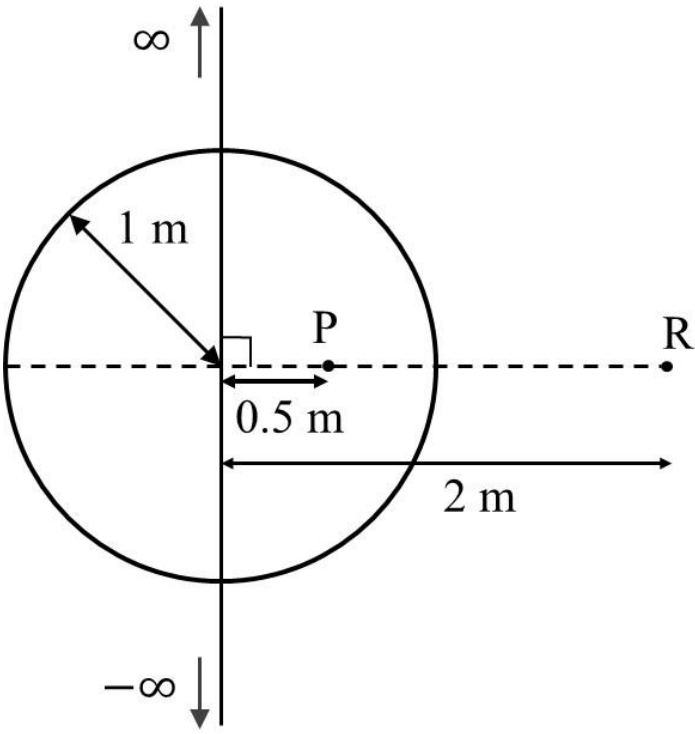
To find the magnitude of the potential difference between points P and R, we can use the principle of superposition by considering the contributions from the uniformly charged spherical shell and the infinitely long thin wire separately.
1. Contribution from the Spherical Shell
Let P be the center of the spherical shell with radius Rshell=1 m and total charge Q=10 nC=10×10−9 C.
-
At Point P (Center of the Shell):
Since point P lies inside the spherical shell, the potential due to the shell is uniform and equal to its surface potential:
Vshell(P)=4πϵ01RshellQ
Substituting the given values:
Vshell(P)=(9×109)×110×10−9=90 V
-
At Point R (Outside the Shell):
Point R is located at a distance of 2 m from the wire. Since the wire is at a distance of 0.5 m to the left of the center P, the distance dR of point R from the center P is:
dR=2 m−0.5 m=1.5 m
Since dR>Rshell, point R lies outside the spherical shell. The potential due to the shell at point R is:
Vshell(R)=4πϵ01dRQ
Substituting the given values:
Vshell(R)=(9×109)×1.510×10−9=60 V
Thus, the potential difference due to the spherical shell is:
ΔVshell=Vshell(P)−Vshell(R)=90 V−60 V=30 V
2. Contribution from the Infinitely Long Thin Wire
The electric field at a distance r from an infinitely long wire with linear charge density λ=5 nC/m=5×10−9 C/m is:
E(r)=2πϵ0rλ
The potential difference between points P and R due to the wire, where rP=0.5 m and rR=2 m, is given by:
ΔVwire=Vwire(P)−Vwire(R)=∫rPrRE(r)dr=2πϵ0λln(rPrR)
Using 2πϵ01=2×4πϵ01=2×(9×109)=18×109 N⋅m2/C2:
ΔVwire=(18×109)×(5×10−9)×ln(0.52)
ΔVwire=90×ln(4)=90×2ln(2)
Given ln2=0.7:
ΔVwire=180×0.7=126 V
3. Total Potential Difference
By the principle of superposition, the total potential difference between points P and R is:
∣VP−VR∣=ΔVshell+ΔVwire
∣VP−VR∣=30 V+126 V=156 V
156