Equilibrium Position of Diathermic Partition in Isolated Gas Cylinder
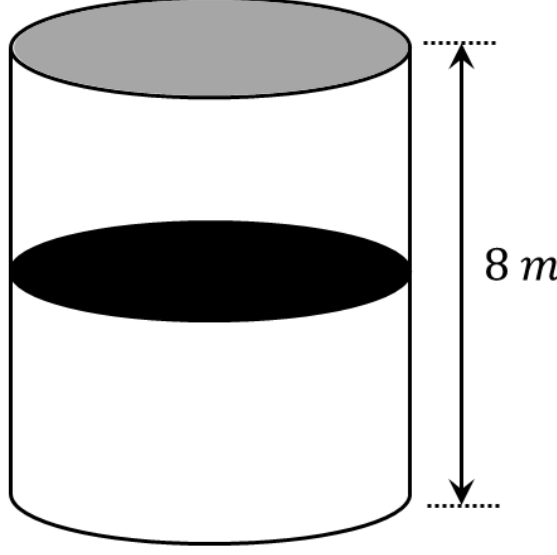
A thermally insulated cylindrical closed vessel with height is held vertically. It is partitioned into two equal sections by a diathermic (perfect thermal conductor) frictionless partition of mass . The partition is initially held fixed at a distance of from the top, as illustrated in the schematic diagram. Each of the two compartments contains of an ideal gas at temperature . The partition is released and moves without any leakage of gas between compartments. When equilibrium is attained, the distance of the partition measured from the top (in ) will be ______. (Take acceleration due to gravity and universal gas constant ).
Topics & Concepts
Step-by-Step Solution
To find the distance of the partition from the top at equilibrium, we analyze the forces acting on the diathermic partition when the system reaches mechanical and thermal equilibrium.
1. Given Data
- Total height of the vessel,
- Initial position of the partition from the top,
- Mass of the partition,
- Number of moles of gas in each compartment,
- Temperature at equilibrium,
- Acceleration due to gravity,
- Universal gas constant,
2. Equilibrium Equations
Let be the distance of the partition from the top in meters at equilibrium, and let be the cross-sectional area of the cylinder.
-
Volume of the top compartment:
-
Volume of the bottom compartment:
Since the partition is diathermic, thermal equilibrium ensures that both compartments have the same temperature .
Using the ideal gas equation :
-
Pressure in the top compartment ():
-
Pressure in the bottom compartment ():
3. Mechanical Equilibrium
At equilibrium, the upward force exerted by the bottom gas balances the downward force exerted by the top gas and the weight of the partition:
Dividing both sides by :
Substitute the expressions for and :
Canceling from both sides:
Factoring out :
4. Numerical Calculation
First, evaluate the terms and :
Substitute these values into the equilibrium equation:
Divide both sides by :
Rearranging into standard quadratic form:
Factorizing the quadratic equation:
Since represents a physical distance inside the cylinder, :
Final Answer
The distance of the partition measured from the top when equilibrium is attained will be 6.