Work Done Bringing Point Dipole Near Suspended Charge
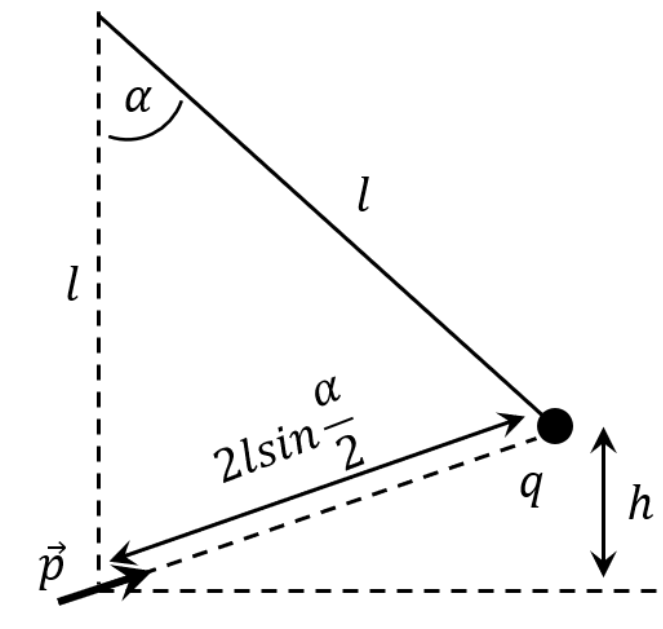
A point charge having mass is suspended vertically using a string of length . A point dipole with dipole moment is brought towards starting from infinity such that the charge is displaced. The final equilibrium position of the system along with dipole direction, angles, and distances is shown in the figure below. If the work done in bringing the dipole to this position is , where is the acceleration due to gravity, then determine the value of . (Note that for three coplanar forces keeping a point mass in equilibrium, is the same for all forces, where represents any one of the forces and is the angle between the remaining two forces)
Step-by-Step Solution
To find the value of , we analyze the equilibrium of the suspended charge and calculate the total work done by the external agent to bring the dipole from infinity to its final position.
1. Geometry of the System
Let the suspension point be , the initial position of the charge be (at a vertical distance below ), and the final position of the charge be .
- The distance from the suspension point to the dipole at is .
- The length of the string is .
- The angle made by the string with the vertical is .
In the isosceles triangle formed by sides and :
- The distance between the dipole at and the charge at is:
- The vertical height by which the mass is raised is:
Thus, the increase in gravitational potential energy of the mass is:
2. Equilibrium of Charge (Lami's Theorem)
Three forces act on the charge at position :
- Gravitational force , acting vertically downwards.
- Tension , acting along the string towards (making an angle with the vertical).
- Electrostatic force , acting along the line (away from the dipole at ).
From the geometry of the isosceles triangle , the line makes an angle with the horizontal, so the angle between and the downward vertical is .
The angles between the three forces are:
- Angle between and :
- Angle between and :
- Angle between and :
Applying Lami's Theorem:
Using the identity :
3. Electrostatic Potential Energy of the System
The electrostatic potential energy of a point charge in the field of a point dipole at a distance along its axis varies as:
The magnitude of the electrostatic force is related to the potential energy by:
Therefore, the electrostatic potential energy in the final configuration is:
Substituting and :
4. Total Work Done
Since the process is performed quasi-statically (), the work done by the external agent is equal to the total change in potential energy of the system:
Comparing this with , we get: