Reimer Tiemann Reaction of Para Cresol Products
For the specified reaction condition involving chloroform and hydroxide base acting on the substrate, select the correct product(s) formed:
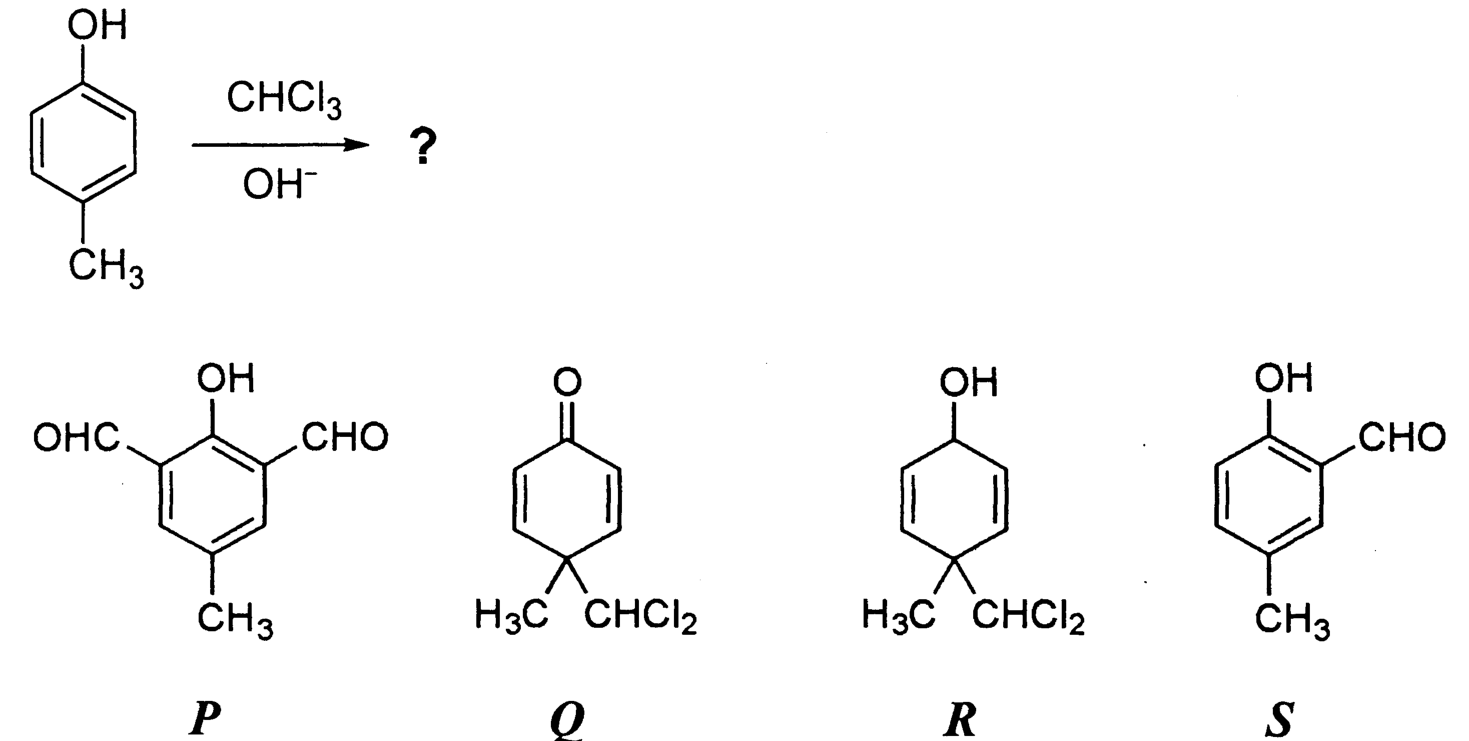
Options
(major)
(minor)
(minor)
(major)
Step-by-Step Solution
To determine the product(s) formed in the Reimer-Tiemann reaction of -cresol (-methylphenol) with chloroform () in the presence of a strong base (), we analyze the step-by-step reaction mechanism:
1. Generation of Electrophile
Chloroform reacts with hydroxide base via deprotonation followed by loss of a chloride ion to generate dichlorocarbene (), an electron-deficient, neutral electrophile:
Simultaneously, -cresol is deprotonated by to form the more reactive nucleophile, -methylphenoxide ion.
2. Attack of Electrophile
Case I: Ortho Attack (Formation of Major Product )
The -methylphenoxide ion undergoes electrophilic aromatic substitution at the unoccupied ortho-position:
- The phenoxide ion attacks at the ortho-position to give a cyclohexadienyl anion intermediate.
- Proton shift restores aromaticity, yielding the -dichloromethyl substituted intermediate.
- Alkaline hydrolysis of the group converts it into a formyl group ():
This leads to 2-hydroxy-5-methylbenzaldehyde (). Because aromaticity is fully restored during this path, is the major product.
Case II: Para Attack / Ipso Attack (Formation of Minor Product )
The phenoxide ion can also attack the electrophile at the para-position (ipso to the methyl group):
- The electrophilic attack forms a intermediate where the para-carbon carries both the methyl () group and the group.
- Proton abstraction from this para-position is not possible because the para-carbon is quaternary (it lacks a hydrogen atom).
- As a result, the intermediate cannot undergo tautomerization to restore aromaticity.
- Protonation of the negative charge on dichloromethyl carbon gives the stable non-aromatic dienone structure, 4-methyl-4-(dichloromethyl)cyclohexa-2,5-dien-1-one ().
Because loss of aromatic stability makes this pathway less favorable, is formed as a minor (abnormal Reimer-Tiemann) product.
Conclusion
- is formed as the major product (normal Reimer-Tiemann product).
- is formed as the minor product (abnormal Reimer-Tiemann product).
Therefore, the correct choices are (B) and (D).