JEE Challenger
More from Electric Charges and Fields

Electric Flux through Cubical Surface Due to Enclosed Charge Distribution

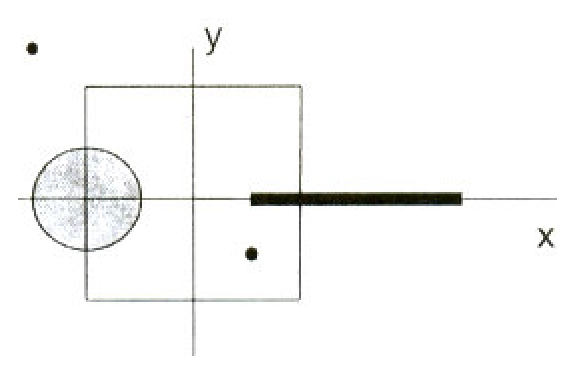
A disk of radius a/4a/4 having a uniformly distributed charge 6C6\text{C} is placed in the xx-yy plane with its centre at (−a/2,0,0)(-a/2, 0, 0). A rod of length aa carrying a uniformly distributed charge 8C8\text{C} is placed on the xx-axis from x=a/4x = a/4 to x=5a/4x = 5a/4. Two point charges −7C-7\text{C} and 3C3\text{C} are placed at (a/4,−a/4,0)(a/4, -a/4, 0) and (−3a/4,3a/4,0)(-3a/4, 3a/4, 0), respectively. Consider a cubical surface formed by six surfaces x=±a/2x = \pm a/2, y=±a/2y = \pm a/2, z=±a/2z = \pm a/2.

Diagram 0

The electric flux through this cubical surface is

Options

A

−2Cε0\frac{-2\text{C}}{\varepsilon_0}

Correct
B

2Cε0\frac{2\text{C}}{\varepsilon_0}

C

10Cε0\frac{10\text{C}}{\varepsilon_0}

D

12Cε0\frac{12\text{C}}{\varepsilon_0}

Step-by-Step Solution

To find the total electric flux through the cubical surface, we use Gauss's Law:
Φ=qenclosedε0\Phi = \frac{q_{\text{enclosed}}}{\varepsilon_0}

The cubical surface encloses the region defined by:
−a2≤x≤a2,−a2≤y≤a2,−a2≤z≤a2-\frac{a}{2} \le x \le \frac{a}{2}, \quad -\frac{a}{2} \le y \le \frac{a}{2}, \quad -\frac{a}{2} \le z \le \frac{a}{2}

Now, we evaluate the charge enclosed from each component of the distribution:

  1. The Charged Disk:

    • The disk has a total charge of 6 C6\text{ C}, radius R=a/4R = a/4, lies in the xx-yy plane (z=0z=0), and is centered at (−a2,0,0)\left(-\frac{a}{2}, 0, 0\right).
    • Its equation is (x+a2)2+y2≤(a4)2\left(x + \frac{a}{2}\right)^2 + y^2 \le \left(\frac{a}{4}\right)^2.
    • The plane x=−a2x = -\frac{a}{2} bisects the disk into two equal halves. Since the cube's interior covers x≥−a2x \ge -\frac{a}{2}, exactly half of the disk lies inside the cube (as the yy-coordinates of the disk range within [−a4,a4]⊂[−a2,a2]\left[-\frac{a}{4}, \frac{a}{4}\right] \subset \left[-\frac{a}{2}, \frac{a}{2}\right] and z=0z=0).
    • Therefore, the charge enclosed from the disk is:
      q1=12×6 C=3 Cq_1 = \frac{1}{2} \times 6\text{ C} = 3\text{ C}
  2. The Charged Rod:

    • The rod has a length aa and carries a uniform charge of 8 C8\text{ C}, so its linear charge density is:
      λ=8 Ca\lambda = \frac{8\text{ C}}{a}
    • The rod lies on the xx-axis from x=a4x = \frac{a}{4} to x=5a4x = \frac{5a}{4}.
    • The cube extends up to x=a2x = \frac{a}{2}, so the portion of the rod inside the cube is from x=a4x = \frac{a}{4} to x=a2x = \frac{a}{2}.
    • The enclosed length is Δx=a2−a4=a4\Delta x = \frac{a}{2} - \frac{a}{4} = \frac{a}{4}.
    • Therefore, the charge enclosed from the rod is:
      q2=λ⋅Δx=(8 Ca)(a4)=2 Cq_2 = \lambda \cdot \Delta x = \left(\frac{8\text{ C}}{a}\right) \left(\frac{a}{4}\right) = 2\text{ C}
  3. The Point Charge −7 C-7\text{ C}:

    • Position: (a4,−a4,0)\left(\frac{a}{4}, -\frac{a}{4}, 0\right).
    • Since −a2<a4<a2-\frac{a}{2} < \frac{a}{4} < \frac{a}{2}, −a2<−a4<a2-\frac{a}{2} < -\frac{a}{4} < \frac{a}{2}, and −a2<0<a2-\frac{a}{2} < 0 < \frac{a}{2}, this point charge lies completely inside the cube.
    • Therefore:
      q3=−7 Cq_3 = -7\text{ C}
  4. The Point Charge 3 C3\text{ C}:

    • Position: (−3a4,3a4,0)\left(-\frac{3a}{4}, \frac{3a}{4}, 0\right).
    • Since −3a4<−a2-\frac{3a}{4} < -\frac{a}{2} and 3a4>a2\frac{3a}{4} > \frac{a}{2}, this point lies entirely outside the cube.
    • Therefore:
      q4=0q_4 = 0

The total charge enclosed by the cubical surface is:
qenclosed=q1+q2+q3+q4=3 C+2 C−7 C+0=−2 Cq_{\text{enclosed}} = q_1 + q_2 + q_3 + q_4 = 3\text{ C} + 2\text{ C} - 7\text{ C} + 0 = -2\text{ C}

Applying Gauss's Law, the electric flux is:
Φ=qenclosedε0=−2 Cε0\Phi = \frac{q_{\text{enclosed}}}{\varepsilon_0} = \frac{-2\text{ C}}{\varepsilon_0}

Thus, the correct option is A.