JEE Challenger
More from Oscillations

Acceleration of Particle from Displacement Time Graph in SHM

The xx-tt graph of a particle undergoing simple harmonic motion is shown below.
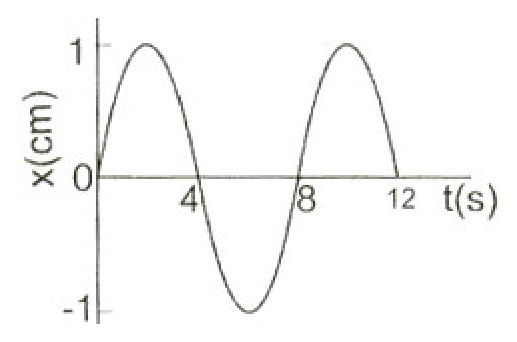
Diagram 0

The acceleration of the particle at t=4/3 st = 4/3\text{ s} is

Options

A

332π2 cm/s2\frac{\sqrt{3}}{32} \pi^2\text{ cm/s}^2

B

−π232 cm/s2-\frac{\pi^2}{32}\text{ cm/s}^2

C

π232 cm/s2\frac{\pi^2}{32}\text{ cm/s}^2

D

−332π2 cm/s2-\frac{\sqrt{3}}{32} \pi^2\text{ cm/s}^2

Correct

Topics & Concepts

Step-by-Step Solution

From the given xx-tt graph, the particle undergoes simple harmonic motion (SHM).

  1. Amplitude and Time Period:

    • The maximum displacement (amplitude) of the particle is:
      A=1 cmA = 1\text{ cm}
    • The particle starts at x=0x = 0 with a positive velocity at t=0 st = 0\text{ s} and completes one full oscillation at t=8 st = 8\text{ s}. Thus, the time period of oscillation is:
      T=8 sT = 8\text{ s}
  2. Angular Frequency:
    The angular frequency ω\omega is given by:
    ω=2πT=2π8=π4 rad/s\omega = \frac{2\pi}{T} = \frac{2\pi}{8} = \frac{\pi}{4}\text{ rad/s}

  3. Equation of Motion:
    Since x(0)=0x(0) = 0 and the particle is moving in the positive direction initially, the displacement as a function of time can be written as:
    x(t)=Asin⁡(ωt)=sin⁡(π4t) cmx(t) = A \sin(\omega t) = \sin\left(\frac{\pi}{4} t\right)\text{ cm}

  4. Displacement at t=43 st = \frac{4}{3}\text{ s}:
    x(43)=sin⁡(π4×43)=sin⁡(π3)=32 cmx\left(\frac{4}{3}\right) = \sin\left(\frac{\pi}{4} \times \frac{4}{3}\right) = \sin\left(\frac{\pi}{3}\right) = \frac{\sqrt{3}}{2}\text{ cm}

  5. Acceleration of the Particle:
    The acceleration a(t)a(t) in simple harmonic motion is related to the displacement by:
    a(t)=−ω2x(t)a(t) = -\omega^2 x(t)

    Substituting the values at t=43 st = \frac{4}{3}\text{ s}:
    a=−(π4)2×(32)=−π216×32=−332π2 cm/s2a = -\left(\frac{\pi}{4}\right)^2 \times \left(\frac{\sqrt{3}}{2}\right) = -\frac{\pi^2}{16} \times \frac{\sqrt{3}}{2} = -\frac{\sqrt{3}}{32}\pi^2\text{ cm/s}^2

Therefore, the correct option is D.