Electric Flux Through Cube Faces with Enclosed Point Charges
Consider a cubical region of side length with its center located at the origin. It encloses three fixed point charges: at , at , and at . Select the correct option(s).
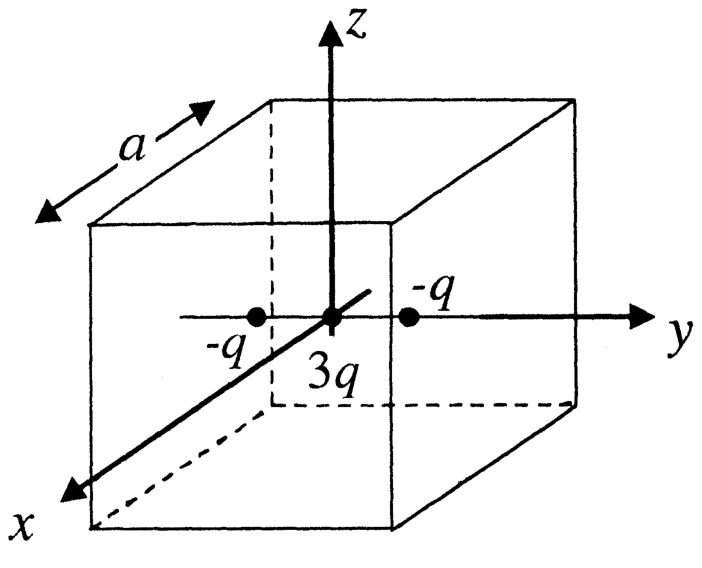
Options
The net electric flux through the plane is equal to that through the plane .
The net electric flux crossing the plane is greater than the flux crossing the plane .
The total electric flux passing through the whole cubical boundary is .
The net electric flux crossing the plane is equal to the net electric flux crossing the plane .
Topics & Concepts
Step-by-Step Solution
To solve this problem, we analyze the charge distribution and apply Gauss's Law along with spatial symmetry arguments.
1. Total Electric Flux Through the Cube (Option C)
According to Gauss's Law, the total electric flux passing through any closed surface is proportional to the total net charge enclosed within that surface:
The cubical region of side length centered at the origin encloses three point charges:
- at
- at
- at
The net enclosed charge is:
Therefore, the total flux through the cubical surface is:
Thus, Option C is correct.
2. Comparison of Flux through and (Option A)
All three charges lie on the -axis ().
Since the charge distribution is symmetric about the - plane (), performing a reflection across () leaves the charge distribution completely unchanged.
By this mirror symmetry, the electric field lines exiting through the face at are symmetric to those exiting through the face at . Thus, the net electric flux crossing the plane is equal to that crossing the plane :
Thus, Option A is correct.
3. Comparison of Flux through and (Option B)
The charges are located at , , and .
Notice that the charge distribution is symmetric under reflection across the - plane (), because:
- The charge at is .
- The charge at is .
- The charge at is .
Reflecting the system across swaps the two charges and leaves at the origin, resulting in the exact same charge configuration. Therefore, the net electric flux through the face must be equal to the net electric flux through the face :
Since the flux through is equal to (not greater than) the flux through , Option B is incorrect.
4. Comparison of Flux through and (Option D)
Since all three charges lie entirely along the -axis, the charge distribution possesses continuous rotational symmetry (cylindrical symmetry) about the -axis.
Rotating the system about the -axis by maps the -axis onto the -axis. The square face located at (defined by ) maps perfectly onto the square face located at (defined by ).
Due to this axial symmetry about the -axis, the electric flux through the plane is equal to the electric flux through the plane :
Thus, Option D is correct.
Conclusion
The correct options are A, C, and D.