Image Distance Formed by Combination of Two Lenses
A composite bi-convex lens is constructed using two thin plano-convex lenses as illustrated in the figure. The refractive index of the first lens is and that of the second lens is . Both curved surfaces have an identical radius of curvature . For an object positioned at a distance of from this bi-convex lens, the resulting image distance is:
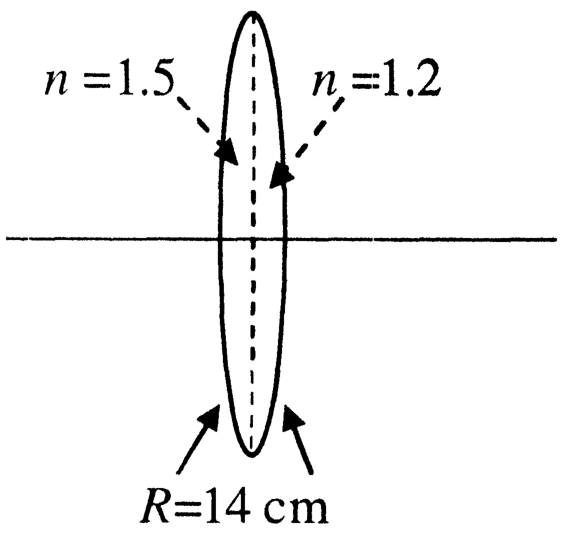
Options
Step-by-Step Solution
To find the image distance formed by the combination of the two thin plano-convex lenses, we first calculate the focal length of each individual lens using the Lens Maker's formula:
1. Focal length of the first lens ():
For the first lens:
- Refractive index,
- Radius of curvature of the first (curved) surface,
- Radius of curvature of the second (flat) surface,
2. Focal length of the second lens ():
For the second lens:
- Refractive index,
- Radius of curvature of the first (flat) surface,
- Radius of curvature of the second (curved) surface,
3. Equivalent focal length of the combination ():
Since the two thin lenses are placed in contact, their equivalent power is the sum of their individual powers:
Taking the least common multiple of and , which is :
Thus, the equivalent focal length of the combination is:
4. Determination of the Image Distance ():
Using the thin lens formula:
Given:
- Object distance,
- Equivalent focal length,
Substituting these values into the formula:
Hence, the resulting image distance is .
Correct Option: B