Electric Field Potential Magnetic Field and Moment of Rotating Charges
Six point charges, each of the same magnitude , are arranged in different manners as shown in Column II. In each case, a point and a line passing through are shown. Let be the electric field and be the electric potential at (potential at infinity is zero) due to the given charge distribution when it is at rest. Now, the whole system is set into rotation with a constant angular velocity about the line . Let be the magnetic field at and be the magnetic moment of the system in this condition. Assume each rotating charge to be equivalent to a steady current.
Column I
(A)
(B)
(C)
(D)
Column II
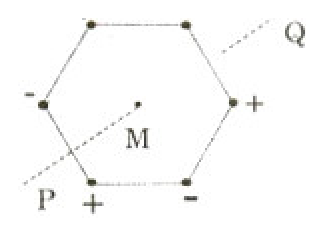
(p) Charges are at the corners of a regular hexagon. is at the centre of the hexagon. is perpendicular to the plane of the hexagon.
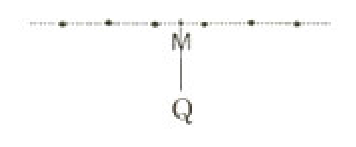
(q) Charges are on a line perpendicular to at equal intervals. is the mid-point between the two innermost charges.
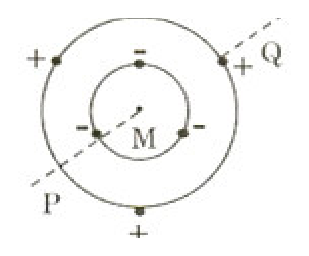
(r) Charges are placed on two coplanar insulating rings at equal intervals. is the common centre of the rings. is perpendicular to the plane of the rings.
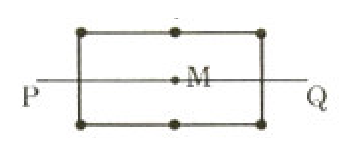
(s) Charges are placed at the corners of a rectangle of sides and and at the mid points of the longer sides. is at the centre of the rectangle. is parallel to the longer sides.
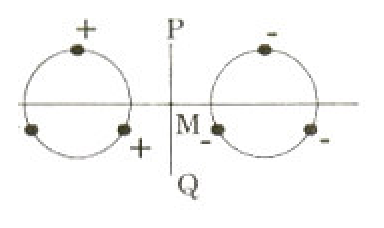
(t) Charges are placed on two coplanar, identical insulating rings at equal intervals. is the mid-point between the centres of the rings. is perpendicular to the line joining the centres and coplanar to the rings.
Options
(A) p, r, s
(B) r, s
(C) p, q, t
(D) r, s
Step-by-Step Solution
To find the correct match for each entry in Column I, we analyze each configuration given in Column II:
Analysis of Configurations in Column II:
- Configuration (p):
- Charges and Geometry: Six charges arranged at the vertices of a regular hexagon. Three charges are forming an equilateral triangle, and the other three are forming another inverted equilateral triangle.
- Electric Field (): The electric fields due to the three symmetric charges at the center cancel out to zero (). Similarly, the electric fields due to the three charges cancel out (). Thus, the net electric field is:
- Electric Potential (): All charges are at an equal distance from the center . The sum of charges is . Therefore:
- Magnetic Field () and Magnetic Moment (): The line is perpendicular to the plane of the hexagon and passes through . When rotated about , all charges move in circles of radius . The equivalent circular current due to the positive charges is , and due to the negative charges is . The net circulating current is zero:
- Matches: (p) satisfies and .
- Configuration (q):
- Charges and Geometry: Six charges are arranged symmetrically about along a line perpendicular to . At each symmetric distance from , there is a pair of opposite charges and .
- Electric Field (): Since opposite charges lie on opposite sides of , their electric fields at the midpoint point in the same direction and reinforce each other:
- Electric Potential (): At each distance , the pair contributes and , so their potentials cancel pairwise:
- Magnetic Field () and Magnetic Moment (): During rotation about , each pair of charges at distance traces out the same circle of radius . The net charge on any circle is , producing zero net circular current at each radius:
- Matches: (q) satisfies .
- Configuration (r):
- Charges and Geometry: The charges are arranged symmetrically on two concentric coplanar rings with their common center at . The net charge of the system is non-zero ().
- Electric Field (): By circular symmetry of the equal-interval charge distribution on each ring:
- Electric Potential (): Since the net charge is non-zero:
- Magnetic Field () and Magnetic Moment (): The rotation axis passes perpendicularly through the common center . The rotation creates concentric circular currents with a non-zero net circulating charge:
- Matches: (r) satisfies , , and .
- Configuration (s):
- Charges and Geometry: Six charges are placed at the vertices and midpoints of the longer sides of a rectangle. The charge distribution is symmetric such that identical charges face each other across the center , and the net charge is non-zero.
- Electric Field (): Equal charges are located diametrically opposite to each other across the center , so their electric field vectors cancel pairwise:
- Electric Potential (): Since the total charge is non-zero:
- Magnetic Field () and Magnetic Moment (): Rotation about the line of symmetry produces non-zero equivalent current loops that generate a net magnetic field at and a net magnetic dipole moment:
- Matches: (s) satisfies , , and .
- Configuration (t):
- Charges and Geometry: Two identical rings carrying charges such that the net charge on the left ring is and on the right ring is . is the midpoint between the centers of the rings.
- Electric Field (): The fields from the positively charged ring and negatively charged ring point in the same direction at :
- Electric Potential (): By anti-symmetry about the perpendicular bisector line , the potential from the positive ring and negative ring cancel at every point on the plane of symmetry containing :
- Magnetic Field () and Magnetic Moment (): Due to the anti-symmetric arrangement of charges about the rotation axis , the magnetic field generated at and the total magnetic dipole moment cancel out:
- Matches: (t) satisfies .
Matching Summary:
- (A) p, r, s
- (B) r, s
- (C) p, q, t
- (D) r, s