Matrix Match of Forces Energy and Torque in Mechanical Systems
Column II shows five systems in which two objects are labelled as and . Also in each case a point is shown. Column I gives some statements about and/or . Match these statements to the appropriate system(s) from Column II.
Column I
(A) The force exerted by on has a magnitude .
(B) The gravitational potential energy of is continuously increasing.
(C) Mechanical energy of the system is continuously decreasing.
(D) The torque of the weight of about point is zero.
Column II
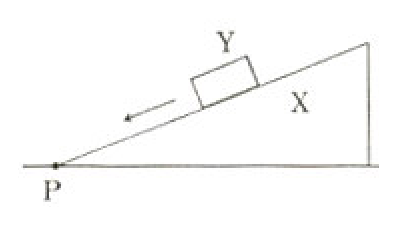
(p) Block of mass left on a fixed inclined plane , slides on it with a constant velocity.
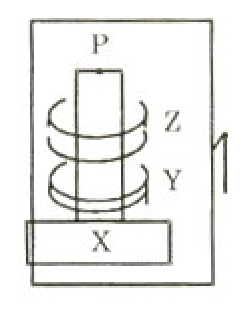
(q) Two ring magnets and , each of mass , are kept in frictionless vertical plastic stand so that they repel each other. rests on the base and hangs in air in equilibrium. is the topmost point of the stand on the common axis of the two rings. The whole system is in a lift that is going up with a constant velocity.
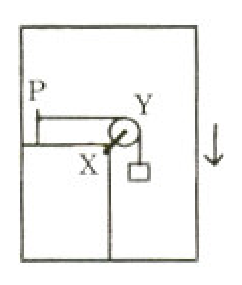
(r) A pulley of mass is fixed to a table through a clamp . A block of mass hangs from a string that goes over the pulley and is fixed at point of the table. The whole system is kept in a lift that is going down with a constant velocity.
(s) A sphere of mass is put in a nonviscous liquid kept in a container at rest. The sphere is released and it moves down in the liquid.
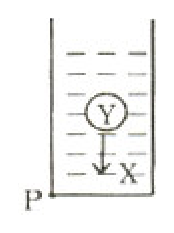
(t) A sphere of mass is falling with its terminal velocity in a viscous liquid kept in a container.
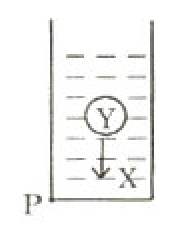
Options
(A) (p), (t)
(B) (q), (s), (t)
(C) (p), (r), (t)
(D) (q)
Step-by-Step Solution
To match each statement in Column I to the appropriate system(s) in Column II, we analyze each physical scenario in detail:
Analysis of Statement (A): The force exerted by on has a magnitude .
-
System (p):
- Block of mass slides down the fixed inclined plane at a constant velocity, meaning its acceleration is zero ().
- From Newton's second law:
- The magnitude of the contact force exerted by on (the resultant of normal reaction and friction) is:
- Hence, (p) matches (A).
-
System (q):
- Magnet of mass hangs in equilibrium above ring magnet , so the magnetic repulsion between them is .
- Ring magnet (mass ) rests on the base and moves with constant velocity. The forces acting on in the vertical direction are its weight (downward), magnetic repulsion from of magnitude (downward), and the normal force from (upward):
- Thus, the force exerted by on is .
-
System (r):
- The pulley of mass experiences the downward tension from the hanging mass, a horizontal tension from the anchored string, and its own weight . The net force exerted by clamp on balances these forces and does not have a magnitude of .
-
System (s):
- The sphere accelerates downwards in the non-viscous liquid , meaning the buoyant force (the force exerted by the liquid on ) is strictly less than its weight: .
-
System (t):
- The sphere falls with terminal velocity (constant velocity, ) in the viscous liquid .
- By equilibrium of the sphere:
- Hence, (t) matches (A).
Conclusion for (A):
Analysis of Statement (B): The gravitational potential energy of is continuously increasing.
-
System (p):
- Inclined plane is fixed; its position does not change, so its potential energy is constant.
-
System (q):
- The base is inside a lift moving upwards with constant velocity. As its vertical coordinate increases with time, its gravitational potential energy continuously increases.
- Hence, (q) matches (B).
-
System (r):
- The lift is moving downwards, so the height and gravitational potential energy of clamp are continuously decreasing.
-
System (s) and System (t):
- In both cases, as the sphere moves downwards through the liquid , it displaces an equal volume of liquid upwards to occupy the space vacated above it.
- Because liquid is transferred from lower levels to higher levels, the center of mass of the liquid continuously shifts upwards.
- Consequently, the gravitational potential energy of the liquid is continuously increasing.
- Hence, both (s) and (t) match (B).
Conclusion for (B):
Analysis of Statement (C): Mechanical energy of the system is continuously decreasing.
-
System (p):
- Block moves down at constant velocity (constant kinetic energy), so its gravitational potential energy decreases. The inclined plane is stationary. Mechanical energy is dissipated into thermal energy via friction between and .
- Hence, the mechanical energy of is continuously decreasing.
- Thus, (p) matches (C).
-
System (q):
- The lift moves upwards, increasing the potential energy of both and while keeping their kinetic energy constant. Thus, the mechanical energy is increasing.
-
System (r):
- The lift moves downwards at a constant velocity. The kinetic energies of both and remain constant, while their gravitational potential energies continuously decrease. Therefore, the total mechanical energy of is continuously decreasing.
- Thus, (r) matches (C).
-
System (s):
- The liquid is non-viscous and no non-conservative forces act on the system. By conservation of mechanical energy, the mechanical energy of the system remains constant.
-
System (t):
- Due to the viscous drag (a non-conservative dissipative force), mechanical energy is continuously dissipated as heat as the sphere falls at terminal velocity.
- Thus, (t) matches (C).
Conclusion for (C):
Analysis of Statement (D): The torque of the weight of about point is zero.
- The torque of the weight about point is given by:
- This torque is zero if and only if the position vector of the center of mass of relative to is parallel to , meaning that point lies on the vertical line passing through the center of mass of .
- System (p): Point is at the bottom corner of the incline and does not lie on the vertical line passing through the center of mass of block . Thus, .
- System (q): lies on the central vertical axis of the stand, which is also the axis of symmetry of the annular ring magnet . The center of mass of lies on this vertical axis directly below . Hence, the line of action of the weight of passes through , yielding .
- Thus, (q) matches (D).
- Systems (r), (s), (t): In all these systems, point is located away from the vertical line passing through the center of mass of . Hence, the torque is non-zero.
Conclusion for (D):
Final Matching:
- (A) (p), (t)
- (B) (q), (s), (t)
- (C) (p), (r), (t)
- (D) (q)