Distance of Sliding Mass on Rotating Ring System
A ring having mass and radius rotates with angular velocity about a fixed vertical axis passing through its center . Two point masses, each having mass , are initially at rest at . These masses can move radially outward along two massless rods fixed on the ring as illustrated in the figure. At a certain moment, the angular velocity of the system becomes , and one of the point masses is situated at a distance of from . At this instant, the distance of the second mass from is
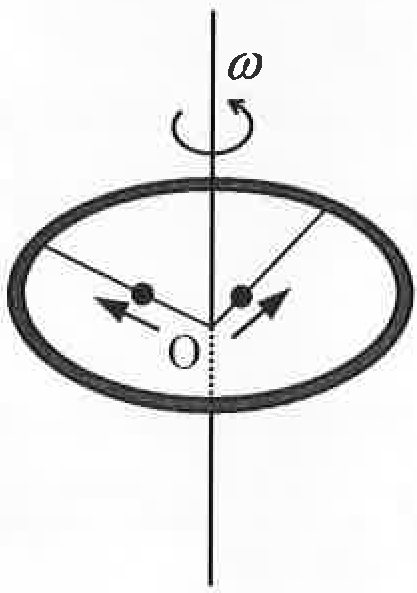
Options
Step-by-Step Solution
To find the distance of the second point mass from the center , we apply the Law of Conservation of Angular Momentum about the fixed vertical axis of rotation passing through , as there are no external torques acting on the system along this axis.
1. Initial State
- Mass of the ring =
- Radius of the ring =
- Initial angular speed =
- Two point masses, each of mass , are initially at the center , so their initial distance from the axis of rotation is .
The initial moment of inertia of the system about the vertical axis passing through is:
The initial angular momentum is:
2. Final State
- Final angular speed
- Distance of the first point mass from is
- Distance of the second point mass from is
The final moment of inertia of the system about the axis of rotation is:
The final angular momentum is:
3. Conservation of Angular Momentum
Since no external torque acts about the axis of rotation, :
Dividing both sides by :
Multiplying both sides by :
Subtracting from both sides:
Thus:
4. Calculating
Substituting into the equation:
Conclusion
- If one mass is at a distance of , the distance of the second mass from is (Option D).
- By symmetry and interchangeability of the two identical masses, the pair of distances of the two masses from at this instant is . Therefore, both options (C) and (D) represent valid distance choices for the masses in the system.
Correct Options: (C) and (D)