JEE Challenger
More from Oscillations

Phase Space Momentum Position Graphs of Two Harmonic Oscillators

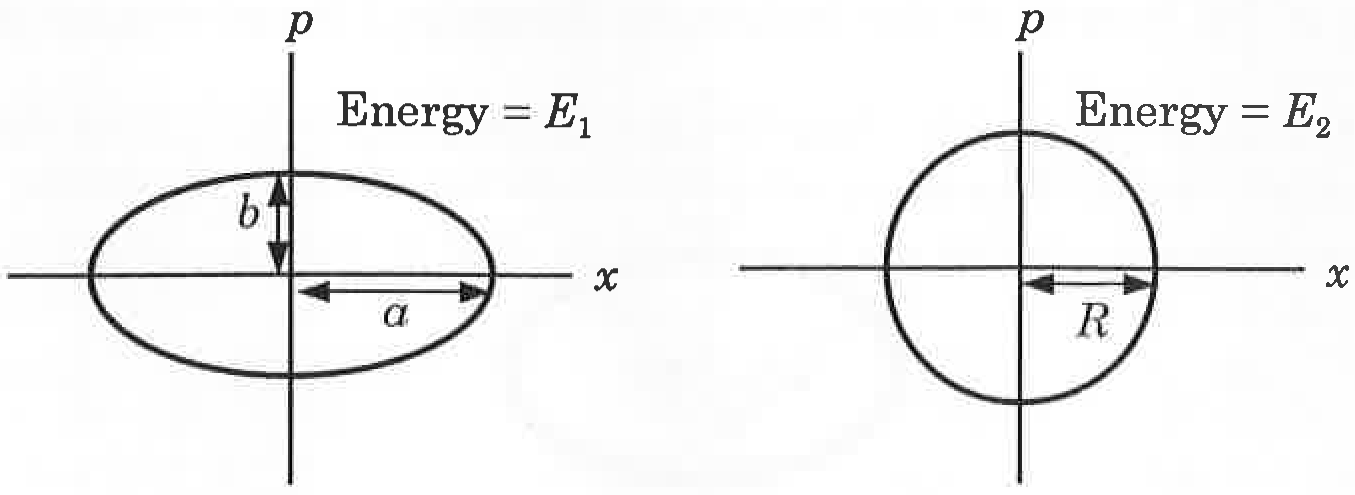
Consider two independent harmonic oscillators of identical mass oscillating about the origin with angular frequencies ω1\omega_1 and ω2\omega_2, having total energies E1E_1 and E2E_2, respectively. The variation of their momentum pp with position xx is depicted in the figures. If ab=n2\frac{a}{b} = n^2 and aR=n\frac{a}{R} = n, then the correct relation(s) is(are)

Question Diagram 1

Options

A

E1ω1=E2ω2E_1\omega_1 = E_2\omega_2

B

ω2ω1=n2\frac{\omega_2}{\omega_1} = n^2

Correct
C

ω1ω2=n2\omega_1\omega_2 = n^2

D

E1ω1=E2ω2\frac{E_1}{\omega_1} = \frac{E_2}{\omega_2}

Correct

Topics & Concepts

Step-by-Step Solution

For a simple harmonic oscillator of mass mm, displacement xx, and momentum pp, the total mechanical energy EE is given by the sum of kinetic and potential energies:

E=p22m+12mω2x2E = \frac{p^2}{2m} + \frac{1}{2}m\omega^2 x^2

Rearranging this into the standard equation of an ellipse in the phase space (x,p)(x, p):

x2(2Emω2)2+p2(2mE)2=1\frac{x^2}{\left(\sqrt{\frac{2E}{m\omega^2}}\right)^2} + \frac{p^2}{\left(\sqrt{2mE}\right)^2} = 1

From the given phase space diagrams:

Oscillator 1:

The phase space trajectory is an ellipse with semi-major axis aa along the xx-axis and semi-minor axis bb along the pp-axis. a=2E1mω12a = \sqrt{\frac{2E_1}{m\omega_1^2}} b=2mE1b = \sqrt{2mE_1}

Taking the ratio of aa to bb: ab=2E1mω122mE1=1mω1\frac{a}{b} = \frac{\sqrt{\frac{2E_1}{m\omega_1^2}}}{\sqrt{2mE_1}} = \frac{1}{m\omega_1}

Given that ab=n2\frac{a}{b} = n^2, we get: 1mω1=n2  ⟹  mω1=1n2— (1)\frac{1}{m\omega_1} = n^2 \implies m\omega_1 = \frac{1}{n^2} \quad \text{--- (1)}


Oscillator 2:

The phase space trajectory is a circle of radius RR. Thus, the semi-axes along xx and pp are both equal to RR: R=2E2mω22=2mE2R = \sqrt{\frac{2E_2}{m\omega_2^2}} = \sqrt{2mE_2}

Equating the two expressions for RR: 2E2mω22=2mE2  ⟹  mω2=1— (2)\sqrt{\frac{2E_2}{m\omega_2^2}} = \sqrt{2mE_2} \implies m\omega_2 = 1 \quad \text{--- (2)}


Step 1: Ratio of Angular Frequencies (ω2ω1\frac{\omega_2}{\omega_1})

Using equations (1) and (2): ω2ω1=mω2mω1=11/n2=n2\frac{\omega_2}{\omega_1} = \frac{m\omega_2}{m\omega_1} = \frac{1}{1/n^2} = n^2

This confirms that Option (B) is correct.


Step 2: Relation between Energy and Angular Frequency

From the expression for bb and RR: E1=b22mandE2=R22mE_1 = \frac{b^2}{2m} \quad \text{and} \quad E_2 = \frac{R^2}{2m}

Now, let's compute the ratio E1ω1\frac{E_1}{\omega_1}: E1ω1=b2/(2m)ω1=b22(mω1)\frac{E_1}{\omega_1} = \frac{b^2 / (2m)}{\omega_1} = \frac{b^2}{2(m\omega_1)}

Substituting mω1=1n2m\omega_1 = \frac{1}{n^2} into the expression: E1ω1=b2n22\frac{E_1}{\omega_1} = \frac{b^2 n^2}{2}

We are given the relations:

  1. ab=n2  ⟹  b=an2\frac{a}{b} = n^2 \implies b = \frac{a}{n^2}
  2. aR=n  ⟹  a=nR\frac{a}{R} = n \implies a = n R

Substituting a=nRa = n R into b=an2b = \frac{a}{n^2}: b=nRn2=Rn  ⟹  bn=Rb = \frac{nR}{n^2} = \frac{R}{n} \implies b n = R

Substituting bn=Rb n = R back into the expression for E1ω1\frac{E_1}{\omega_1}: E1ω1=(bn)22=R22\frac{E_1}{\omega_1} = \frac{(bn)^2}{2} = \frac{R^2}{2}

Next, let's compute E2ω2\frac{E_2}{\omega_2}: E2ω2=R2/(2m)ω2=R22(mω2)\frac{E_2}{\omega_2} = \frac{R^2 / (2m)}{\omega_2} = \frac{R^2}{2(m\omega_2)}

Using mω2=1m\omega_2 = 1: E2ω2=R22\frac{E_2}{\omega_2} = \frac{R^2}{2}

Comparing the two results: E1ω1=E2ω2=R22\frac{E_1}{\omega_1} = \frac{E_2}{\omega_2} = \frac{R^2}{2}

This confirms that Option (D) is correct.


Conclusion:

The correct options are (B) and (D).