Motion of Charges Between Infinite Line Charges After Displacement
The diagrams below show two scenarios where two static, infinitely long line charges possessing uniform positive charge density are positioned parallel to one another. Within their net electric field, point charges and are situated in equilibrium between the lines. These point charges can only move along the -axis. If a small perturbation from their equilibrium state is imparted to each charge, select the true statement(s):
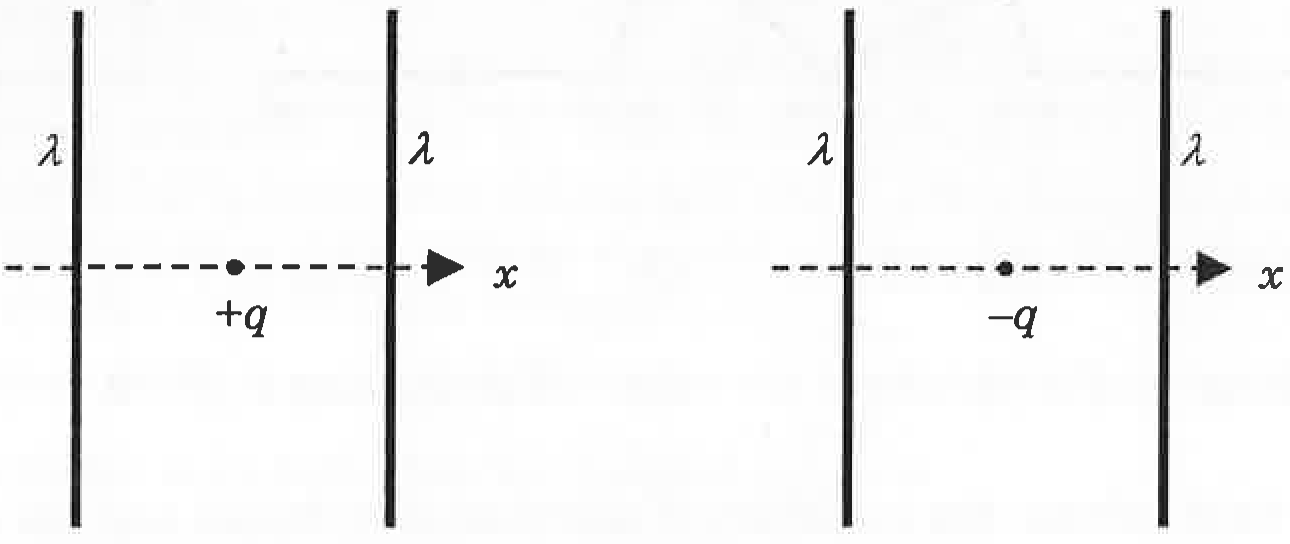
Options
Both point charges undergo simple harmonic motion.
Both point charges keep moving along the direction of their initial displacement.
The charge undergoes simple harmonic motion, whereas the charge keeps moving along its displacement direction.
The charge undergoes simple harmonic motion, whereas the charge keeps moving along its displacement direction.
Topics & Concepts
Step-by-Step Solution
To determine the nature of motion of the charges after a small displacement along the -axis, let us analyze the net electric field between the two parallel, infinitely long line charges.
1. Setup and Electric Field Calculation
Let the two infinitely long line charges, each having a uniform positive charge density , be located at and . The midpoint between them is chosen as the origin , which is the equilibrium position for both point charges.
For any point between the line charges (), the electric field due to each line charge at distance is given by Gauss's Law as .
-
The electric field due to the left line charge at is directed along the -direction:
-
The electric field due to the right line charge at is directed along the -direction:
The net electric field at position is:
For a very small displacement , we can approximate :
2. Analysis of the Motion of
The electrostatic force acting on the charge when displaced by a small distance from the origin is:
- Notice that the restoring force is directed opposite to the displacement ().
- Hence, the equilibrium is stable, and the charge undergoes Simple Harmonic Motion (SHM) with an angular frequency .
3. Analysis of the Motion of
The electrostatic force acting on the charge when displaced by a small distance from the origin is:
- Notice that the force is in the same direction as the displacement ().
- Hence, the equilibrium is unstable, and the force accelerates the charge further away from the equilibrium position.
- Consequently, the charge continues moving along the direction of its initial displacement.
Conclusion
The charge undergoes simple harmonic motion, whereas the charge keeps moving along its displacement direction.
Correct Option: C