Identification of Product S in Organic Reaction Sequence
Paragraph for Question Nos. 16 to 18
A carbonyl compound , which gives positive iodoform test, undergoes reaction with followed by dehydration to give an olefin . Ozonolysis of leads to a dicarbonyl compound , which undergoes intramolecular aldol reaction to give predominantly .
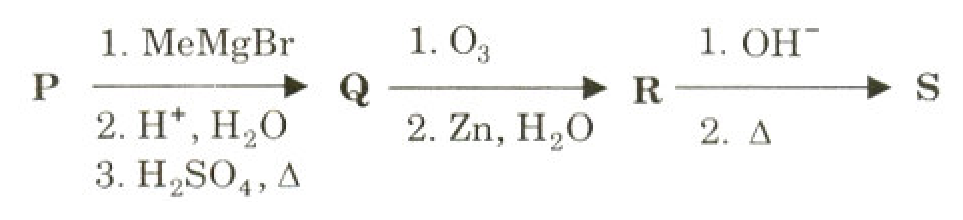
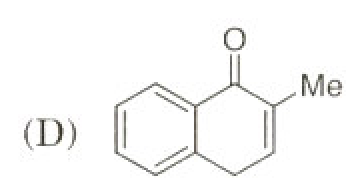
The structure of the product is
Options
Topics & Concepts
Step-by-Step Solution
To determine the structure of the product , we analyze the reaction sequence and the mechanism involved:
-
Identification of the Key Intermediate:
The reaction pathway proceeds via an ortho-disubstituted benzene intermediate bearing a formyl group and a methyl ketone group separated by a quaternary carbon with two methyl groups:
(This keto-aldehyde is typically generated via the reductive ozonolysis of a substituted indene derivative, such as 1,1,2-trimethyl--indene). -
Intramolecular Aldol Condensation:
When this intermediate is treated with a base ():- Enolization occurs exclusively at the methyl group of the acetyl moiety, as the adjacent benzylic carbon is quaternary () and possesses no -hydrogens:
- The enolate nucleophile undergoes an intramolecular nucleophilic addition to the more electrophilic benzylic aldehyde carbonyl group (), forming a stable six-membered ring -hydroxy ketone intermediate.
- Enolization occurs exclusively at the methyl group of the acetyl moiety, as the adjacent benzylic carbon is quaternary () and possesses no -hydrogens:
-
Dehydration to Product :
- Under the reaction conditions, the -hydroxy ketone undergoes base-catalyzed dehydration () to form an -unsaturated ketone.
- The resulting double bond is formed between the benzylic carbon and the -carbon, which establishes an extended conjugated system involving the aromatic benzene ring, the carbon-carbon double bond, and the carbonyl group:
-
Conclusion:
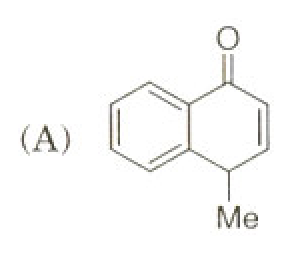
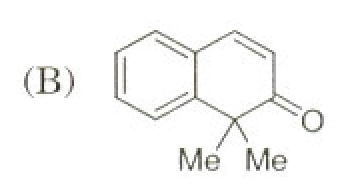
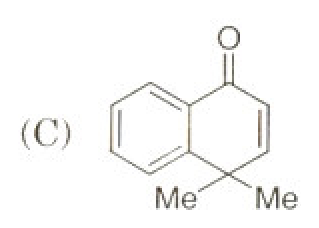
The product obtained is 4,4-dimethylnaphthalen-2(4H)-one, where:- The carbonyl group () is adjacent to the gem-dimethyl group ().
- The double bond is in conjugation with both the carbonyl group and the benzene ring.
This uniquely corresponds to the structure shown in option (B).
Correct Answer: B