Speed of Air Emerging from Spray Gun Nozzle
A spray gun model is illustrated in the diagram, where a piston drives air through an ejection nozzle. A narrow tube with uniform cross-sectional area connects to this nozzle, having its lower end submerged in a small liquid reservoir. When air is expelled through the nozzle by the piston, the liquid is drawn up from the vessel into the nozzle and sprayed out into the environment. In this arrangement, the radius of the piston cylinder is while that of the nozzle is . The top of the reservoir remains exposed to the atmosphere.
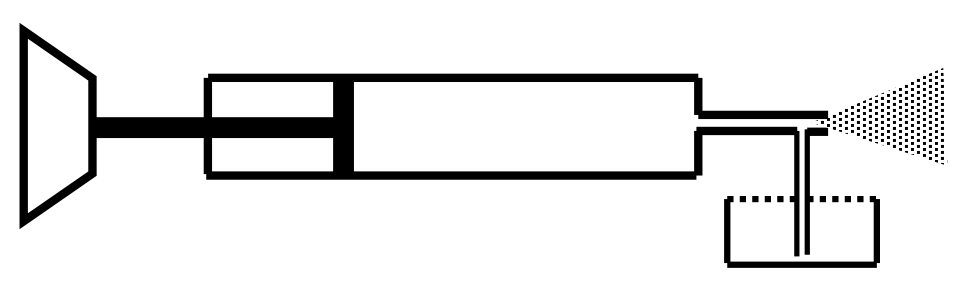
If the piston moves inward at a steady speed of , the speed at which air exits the nozzle is given by
Options
Topics & Concepts
Step-by-Step Solution
To determine the speed at which the air exits the nozzle, we can apply the principle of continuity for fluid flow.
Assuming the air behaves as an incompressible fluid under these steady, low-speed conditions, the volume flow rate inside the cylinder must equal the volume flow rate exiting the nozzle:
where:
- is the cross-sectional area of the piston cylinder, with radius ,
- is the speed of the piston,
- is the cross-sectional area of the nozzle, with radius ,
- is the speed of the air emerging from the nozzle.
Rearranging for :
Substituting the given values:
Converting to meters per second:
Thus, the speed at which air exits the nozzle is , which corresponds to Option (C).