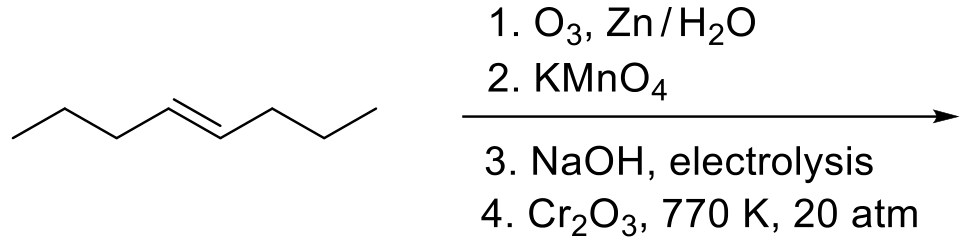
To determine the total number of −CH2− (methylene) groups present in the final organic product, we analyze each step of the reaction sequence:
1. Identification of the Starting Material
The given reactant is oct-4-ene:
CH3−CH2−CH2−CH=CH−CH2−CH2−CH3
2. Reaction Steps
Step 1: Reductive Ozonolysis (O3,Zn/H2O)
Ozonolysis cleaves the central double bond of oct-4-ene to yield 2 moles of butanal:
CH3CH2CH2CH=CHCH2CH2CH3O3,Zn/H2O2CH3CH2CH2CHO
Step 2: Oxidation (KMnO4)
Potassium permanganate oxidizes the aldehyde group of butanal into a carboxylic acid, forming butanoic acid:
CH3CH2CH2CHOKMnO4CH3CH2CH2COOH
Step 3: Kolbe's Electrolysis (NaOH, electrolysis)
Reaction of butanoic acid with NaOH gives sodium butanoate (CH3CH2CH2COONa). Subsequent electrolysis leads to decarboxylative dimerization of the alkyl radicals (CH3CH2CH2∙) to produce n-hexane:
2CH3CH2CH2COONaelectrolysisCH3CH2CH2CH2CH2CH3+2CO2+2Na++2e−
Step 4: Aromatization (Cr2O3,770 K,20 atm)
Heating n-hexane in the presence of Cr2O3 catalyst at 770 K and 20 atm pressure undergoes cyclization and dehydrogenation (aromatization) to form benzene (C6H6):
CH3(CH2)4CH3Cr2O3,770 K,20 atmC6H6+4H2
3. Counting Methylene (−CH2−) Groups in the Final Product
The final product is benzene (C6H6).
All six carbon atoms in benzene are sp2 hybridized and bonded to a single hydrogen atom (=CH− methine group).
Therefore, the number of −CH2− (methylene) groups present in benzene is 0.