Chiral Molecules Produced from Ozonolysis of Polyene P
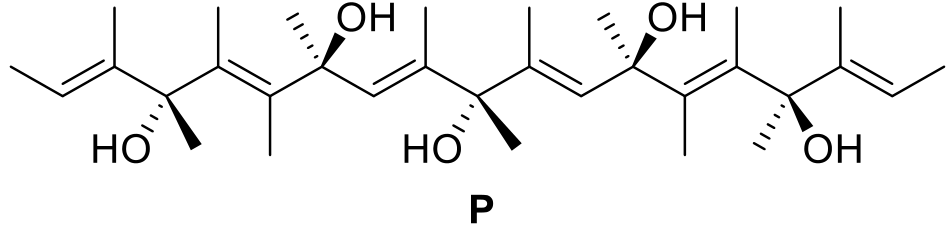
The total number of chiral molecules formed from one molecule of P on complete ozonolysis is ________.
Topics & Concepts
Step-by-Step Solution
To determine the total number of chiral molecules produced from the exhaustive ozonolysis of compound P, we analyze the chemical structure of P and the cleavage products resulting from reductive ozonolysis ().
Step 1: Understanding Reductive Ozonolysis
Reductive ozonolysis using followed by cleaves every carbon-carbon double bond () in the molecule and converts each double-bonded carbon into a carbonyl group ():
Step 2: Structural Analysis of Compound P
Compound P is a polyene containing alternating chiral carbon centers (bearing and groups) separated by trisubstituted double bonds.
Let's identify the repeating units and terminal groups along the main carbon chain of P:
- Left Terminal Group:
- Chiral Carbon Centers ():
Each chiral carbon is bonded to:
- A hydroxyl group ()
- A methyl group ()
- Two carbon chains attached via double bonds on either side.
- Right Terminal Group:
Step 3: Identification of Ozonolysis Fragments
Upon exhaustive ozonolysis of one molecule of P, all double bonds are cleaved:
-
Terminal Achiral Fragments: The terminal double bonds yield acetaldehyde: Acetaldehyde does not possess any chiral carbon and is achiral.
-
Internal Fragments Containing Chiral Centers: Depending on the orientation of the methyl substituents on the adjacent double bonds, the cleavage around a chiral carbon produces a fragment of the general form: where and are the carbonyl-containing groups generated from the left and right double bonds, respectively.
- If a double bond carbon attached to bears a methyl group, it becomes an acetyl group ().
- If a double bond carbon attached to bears a hydrogen atom, it becomes a formyl group ().
For a fragment to be chiral, all four substituents on must be distinct: Since and are fixed:
- The fragment is chiral if (i.e., one group is and the other is ).
- The fragment is achiral if (i.e., both groups are or both are ), as the carbon center will have two identical substituents.
Step 4: Evaluating the Fragments of Compound P
Analyzing the specific substitution pattern of P:
-
Two of the chiral centers generate symmetric fragments where or :
-
Two of the chiral centers generate unsymmetric fragments where and (or vice versa):
Thus, exactly 2 chiral molecules are produced from the complete ozonolysis of one molecule of compound P.
Final Answer:
The total number of chiral molecules formed is 2.