Isomeric Tetraenes Formed from Alkyne Reaction Sequence
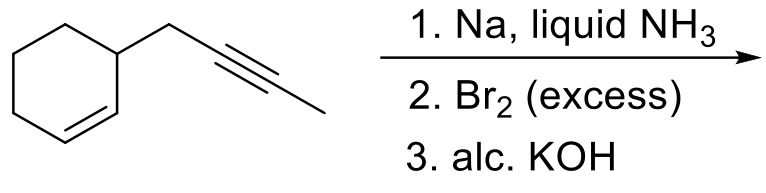
Find the total count of isomeric tetraenes (which do NOT contain any -hybridized carbon atoms) that are synthesized via the reaction sequence shown below.
Official Numerical Answer2
Topics & Concepts
Step-by-Step Solution
To determine the total number of isomeric tetraenes (containing no -hybridized carbon atoms) formed from the given reaction sequence, we analyze each step sequentially:
Step 1: Reduction with
- Starting Material: 3-(but-2-yn-1-yl)cyclohex-1-ene.
- Reaction: Dissolving metal reduction () selectively reduces alkynes to -alkenes (trans-alkenes) while leaving non-conjugated ring double bonds unreacted.
- Product 1: -3-(but-2-en-1-yl)cyclohex-1-ene.
Step 2: Bromination with (excess)
- Reaction: Excess undergoes electrophilic addition across both double bonds (the ring double bond at and the side-chain double bond at ).
- Product 2: Tetrabromo intermediate, 1,2-dibromo-3-(2,3-dibromobutyl)cyclohexane.
- Bromine atoms are attached at carbons and .
Step 3: Elimination with Alcoholic
- Reaction: Dehydrohalogenation ( elimination) removes four molecules of from the tetrabromo intermediate to form a tetraene.
- Constraint: The resulting tetraene must NOT contain any -hybridized carbon atoms (i.e., no allenes or alkynes).
-
Ring Double Bonds:
- To eliminate from and without forming an allene (), double bonds must be formed at and . This yields a stable, conjugated diene within the 6-membered ring.
-
Side-Chain Double Bonds:
- To eliminate from and without forming an allene ( or ), double bonds must be formed at and .
Thus, the structural formula of the tetraene is:
Counting the Isomers
- Ring Double Bonds ( and ): Due to ring strain in a 6-membered ring, both double bonds are restricted strictly to the -configuration.
- Terminal Double Bond (): Since carbon is bonded to two identical hydrogen atoms (), it cannot show geometrical isomerism.
- Acyclic Double Bond (): Carbon is bonded to and the cyclohexadienyl ring, while carbon is bonded to and . Therefore, the double bond exhibits geometrical isomerism and can exist in two forms:
- -isomer
- -isomer
Thus, the total count of isomeric tetraenes formed is 2.