JEE Challenger
More from Oscillations

Dependence of Time Period on Amplitude for Quartic Potential

Comprehension Passage

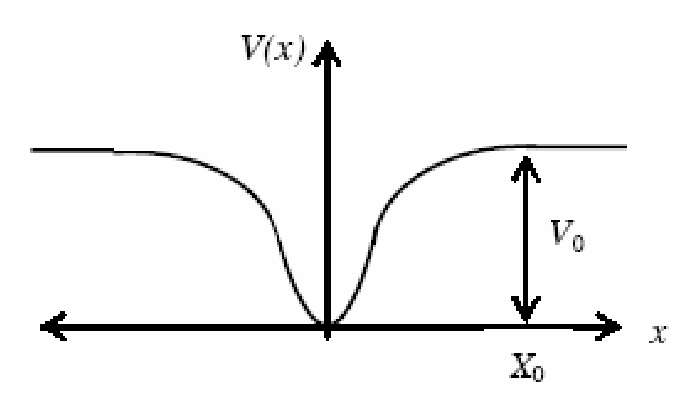
When a particle of mass mm moves on the xx-axis in a potential of the form V(x)=kx2V(x) = kx^2, it performs simple harmonic motion. The corresponding time period is proportional to mk\sqrt{\frac{m}{k}}, as can be seen easily using dimensional analysis. However, the motion of a particle can be periodic even when its potential energy increases on both sides of x=0x = 0 in a way different from kx2kx^2 and its total energy is such that the particle does not escape to infinity. Consider a particle of mass mm moving on the xx-axis. Its potential energy is V(x)=αx4V(x) = \alpha x^4 (α>0\alpha > 0) for ∣x∣|x| near the origin and becomes a constant equal to V0V_0 for ∣x∣≥X0|x| \ge X_0 (see figure).

Passage Diagram 0

For periodic motion of small amplitude AA, the time period TT of this particle is proportional to

Options

A

AmαA \sqrt{\frac{m}{\alpha}}

B

1Amα\frac{1}{A} \sqrt{\frac{m}{\alpha}}

Correct
C

AαmA \sqrt{\frac{\alpha}{m}}

D

1Aαm\frac{1}{A} \sqrt{\frac{\alpha}{m}}

Topics & Concepts

Step-by-Step Solution

To find the dependence of the time period TT on the amplitude AA, mass mm, and the constant α\alpha, we can use both dimensional analysis and direct integration of the equation of motion.

Method 1: Dimensional Analysis

The potential energy of the particle for small amplitude AA (where ∣x∣<X0|x| < X_0) is given by:
V(x)=αx4V(x) = \alpha x^4

From this relation, the dimensions of α\alpha can be determined:
[V]=[Energy]=M L2T−2[V] = [\text{Energy}] = \text{M L}^2 \text{T}^{-2}
[α]=[V][x4]=M L2T−2L4=M L−2T−2[\alpha] = \frac{[V]}{[x^4]} = \frac{\text{M L}^2 \text{T}^{-2}}{\text{L}^4} = \text{M L}^{-2} \text{T}^{-2}

The other relevant physical quantities and their dimensions are:

  • Mass of the particle: [m]=M[m] = \text{M}
  • Amplitude: [A]=L[A] = \text{L}
  • Time period: [T]=T[T] = \text{T}

Assume the time period depends on these quantities as a power law:
T∝maαbAcT \propto m^a \alpha^b A^c

Equating the dimensions on both sides:
[T]=[M]a[M L−2T−2]b[L]c[\text{T}] = [\text{M}]^a [\text{M L}^{-2} \text{T}^{-2}]^b [\text{L}]^c
M0L0T1=Ma+bLc−2bT−2b\text{M}^0 \text{L}^0 \text{T}^1 = \text{M}^{a+b} \text{L}^{c-2b} \text{T}^{-2b}

Comparing exponents for M\text{M}, L\text{L}, and T\text{T}:

  1. For T\text{T}:
    −2b=1  ⟹  b=−12-2b = 1 \implies b = -\frac{1}{2}
  2. For M\text{M}:
    a+b=0  ⟹  a=−b=12a + b = 0 \implies a = -b = \frac{1}{2}
  3. For L\text{L}:
    c−2b=0  ⟹  c=2b=2(−12)=−1c - 2b = 0 \implies c = 2b = 2\left(-\frac{1}{2}\right) = -1

Substituting the exponents back into the relation:
T∝m1/2α−1/2A−1=1AmαT \propto m^{1/2} \alpha^{-1/2} A^{-1} = \frac{1}{A} \sqrt{\frac{m}{\alpha}}


Method 2: Direct Integration

For a particle released from rest at amplitude x=Ax = A, its total mechanical energy EE is purely potential energy:
E=V(A)=αA4E = V(A) = \alpha A^4

By conservation of energy, at any position x∈[−A,A]x \in [-A, A]:
12mv2+V(x)=E\frac{1}{2}m v^2 + V(x) = E
12m(dxdt)2+αx4=αA4\frac{1}{2}m \left(\frac{dx}{dt}\right)^2 + \alpha x^4 = \alpha A^4
dxdt=2αm(A4−x4)\frac{dx}{dt} = \sqrt{\frac{2\alpha}{m}(A^4 - x^4)}

The time period TT is four times the time taken to travel from x=0x = 0 to x=Ax = A:
T=4∫0Adx2αm(A4−x4)=4m2α∫0AdxA4−x4T = 4 \int_{0}^{A} \frac{dx}{\sqrt{\frac{2\alpha}{m}(A^4 - x^4)}} = 4 \sqrt{\frac{m}{2\alpha}} \int_{0}^{A} \frac{dx}{\sqrt{A^4 - x^4}}

Substitute x=Aux = A u, so dx=A dudx = A \, du:
T=4m2α∫01A duA4(1−u4)=4Am2α∫01du1−u4T = 4 \sqrt{\frac{m}{2\alpha}} \int_{0}^{1} \frac{A \, du}{\sqrt{A^4(1 - u^4)}} = \frac{4}{A} \sqrt{\frac{m}{2\alpha}} \int_{0}^{1} \frac{du}{\sqrt{1 - u^4}}

Since the integral ∫01du1−u4\int_{0}^{1} \frac{du}{\sqrt{1 - u^4}} evaluates to a dimensionless numerical constant, we find:
T∝1AmαT \propto \frac{1}{A} \sqrt{\frac{m}{\alpha}}

Thus, the correct option is B.