JEE Challenger
More from Electric Charges and Fields

Concentric Spherical Charge Distributions with Varying Charge Density

In the figure, the inner (shaded) region AA represents a sphere of radius rA=1r_A = 1, within which the electrostatic charge density varies with the radial distance rr from the center as ρA=kr\rho_A = kr, where kk is positive. In the spherical shell BB of outer radius rBr_B, the electrostatic charge density varies as ρB=2kr\rho_B = \frac{2k}{r}. Assume that dimensions are taken care of. All physical quantities are in their SI units.

Which of the following statement(s) is(are) correct?
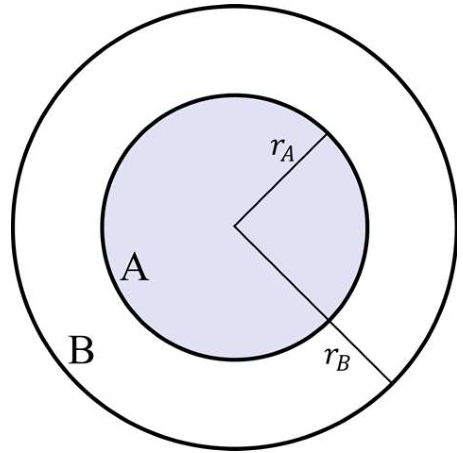
Question Diagram 1

Options

A

If rB=32r_B = \sqrt{\frac{3}{2}}, then the electric field is zero everywhere outside BB.

B

If rB=32r_B = \frac{3}{2}, then the electric potential just outside BB is kϵ0\frac{k}{\epsilon_0}.

Correct
C

If rB=2r_B = 2, then the total charge of the configuration is 15πk15\pi k.

D

If rB=52r_B = \frac{5}{2}, then the magnitude of the electric field just outside BB is 13πkϵ0\frac{13\pi k}{\epsilon_0}.

Step-by-Step Solution

To determine which of the statements are correct, we first calculate the total charge enclosed by region AA and region BB.

Step 1: Charge inside region AA (QAQ_A)

Region AA is a sphere of radius rA=1r_A = 1 with a volumetric charge density ρA=kr\rho_A = kr. Using spherical shells of radius rr and thickness drdr: QA=∫0rAρA(r)⋅4πr2 dr=∫01(kr)⋅4πr2 drQ_A = \int_0^{r_A} \rho_A(r) \cdot 4\pi r^2 \, dr = \int_0^1 (kr) \cdot 4\pi r^2 \, dr QA=4πk∫01r3 dr=4πk[r44]01=πkQ_A = 4\pi k \int_0^1 r^3 \, dr = 4\pi k \left[ \frac{r^4}{4} \right]_0^1 = \pi k

Step 2: Charge inside region BB (QBQ_B)

Region BB is a spherical shell extending from rA=1r_A = 1 to outer radius rBr_B, with charge density ρB=2kr\rho_B = \frac{2k}{r}: QB=∫rArBρB(r)⋅4πr2 dr=∫1rB(2kr)⋅4πr2 drQ_B = \int_{r_A}^{r_B} \rho_B(r) \cdot 4\pi r^2 \, dr = \int_1^{r_B} \left(\frac{2k}{r}\right) \cdot 4\pi r^2 \, dr QB=8πk∫1rBr dr=8πk[r22]1rB=4πk(rB2−1)Q_B = 8\pi k \int_1^{r_B} r \, dr = 8\pi k \left[ \frac{r^2}{2} \right]_1^{r_B} = 4\pi k (r_B^2 - 1)

Step 3: Total Charge of the Configuration (QtotalQ_{\text{total}})

Qtotal=QA+QB=πk+4πk(rB2−1)=πk(4rB2−3)Q_{\text{total}} = Q_A + Q_B = \pi k + 4\pi k(r_B^2 - 1) = \pi k (4r_B^2 - 3)


Step 4: Evaluation of Options

  • Option (A): For the electric field outside region BB to be zero everywhere, the net enclosed charge QtotalQ_{\text{total}} must be zero: Qtotal=0  ⟹  πk(4rB2−3)=0  ⟹  rB=32Q_{\text{total}} = 0 \implies \pi k (4r_B^2 - 3) = 0 \implies r_B = \frac{\sqrt{3}}{2} Since rBr_B must be greater than rA=1r_A = 1, rB=32≈0.866r_B = \frac{\sqrt{3}}{2} \approx 0.866 is physically impossible. Furthermore, substituting rB=32r_B = \sqrt{\frac{3}{2}} into QtotalQ_{\text{total}} gives: Qtotal=πk(4(32)−3)=3πk≠0Q_{\text{total}} = \pi k \left(4 \left(\frac{3}{2}\right) - 3\right) = 3\pi k \neq 0 Therefore, the electric field is non-zero outside BB. Option (A) is incorrect.

  • Option (B): If rB=32r_B = \frac{3}{2}, the total charge is: Qtotal=πk(4(32)2−3)=πk(9−3)=6πkQ_{\text{total}} = \pi k \left( 4 \left(\frac{3}{2}\right)^2 - 3 \right) = \pi k (9 - 3) = 6\pi k The electric potential VV just outside BB (at r=rB=32r = r_B = \frac{3}{2}) is: V=Qtotal4πϵ0rB=6πk4πϵ0(32)=6πk6πϵ0=kϵ0V = \frac{Q_{\text{total}}}{4\pi \epsilon_0 r_B} = \frac{6\pi k}{4\pi \epsilon_0 \left(\frac{3}{2}\right)} = \frac{6\pi k}{6\pi \epsilon_0} = \frac{k}{\epsilon_0} Option (B) is correct.

  • Option (C): If rB=2r_B = 2, the total charge of the configuration is: Qtotal=πk(4(2)2−3)=πk(16−3)=13πkQ_{\text{total}} = \pi k (4(2)^2 - 3) = \pi k (16 - 3) = 13\pi k The option states that the total charge is 15πk15\pi k. Option (C) is incorrect.

  • Option (D): If rB=52r_B = \frac{5}{2}, the total charge is: Qtotal=πk(4(52)2−3)=22πkQ_{\text{total}} = \pi k \left( 4 \left(\frac{5}{2}\right)^2 - 3 \right) = 22\pi k The magnitude of the electric field EE just outside BB is: E=Qtotal4πϵ0rB2=22πk4πϵ0(52)2=22k25ϵ0≠13πkϵ0E = \frac{Q_{\text{total}}}{4\pi \epsilon_0 r_B^2} = \frac{22\pi k}{4\pi \epsilon_0 \left(\frac{5}{2}\right)^2} = \frac{22 k}{25 \epsilon_0} \neq \frac{13\pi k}{\epsilon_0} Option (D) is incorrect.


Conclusion

The correct statement is (B).

Concentric Spherical Charge Distributions with Varying Charge Density | Physics PYQ Solution - JEE Challenger