Concave Mirror and Object Motion Speed Calculation
An object and a concave mirror of focal length both move along the principal axis of the mirror with constant speeds. The object moves with speed towards the mirror with respect to a laboratory frame. The distance between the object and the mirror at a given moment is denoted by . When , the speed of the mirror is such that the image is instantaneously at rest with respect to the laboratory frame, and the object forms a real image. The magnitude of is _____ .
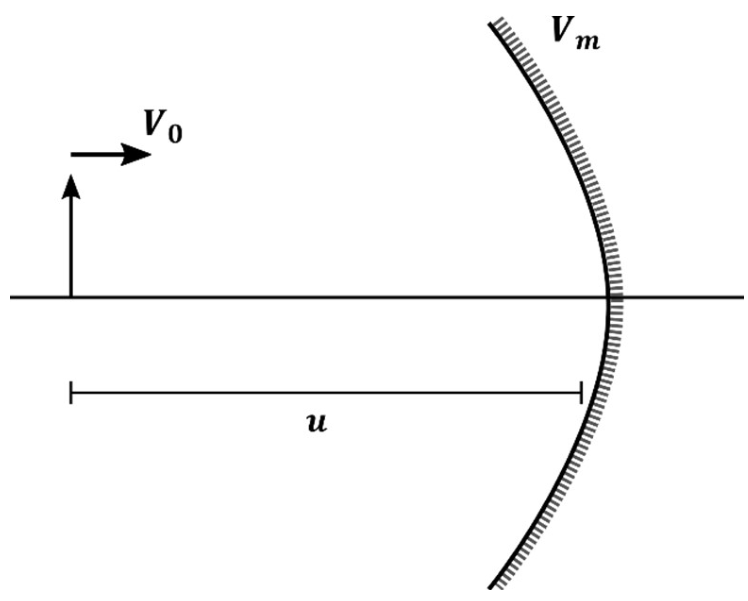
Step-by-Step Solution
To find the magnitude of the mirror's velocity , we set up a one-dimensional coordinate system along the principal axis of the mirror, taking the direction of incident light (to the right) as positive.
1. Find the position of the image relative to the mirror:
Given:
- Focal length of the concave mirror,
- Distance of object relative to mirror,
Using the mirror formula:
Substitute the values:
Thus, the real image is formed in front of the mirror pole.
2. Relate the velocities of the object, mirror, and image:
Differentiating the mirror formula with respect to time :
Here:
- (velocity of object relative to mirror)
- (velocity of image relative to mirror)
Therefore, the velocity relation in the laboratory frame is:
3. Calculate the magnitude of :
Given:
- Velocity of object, (towards the mirror, so in the direction)
- Velocity of image, (instantaneously at rest)
Substitute these into the equation:
The magnitude of is .