Refractive Index Determination Using Critical Angle from Transparent Block
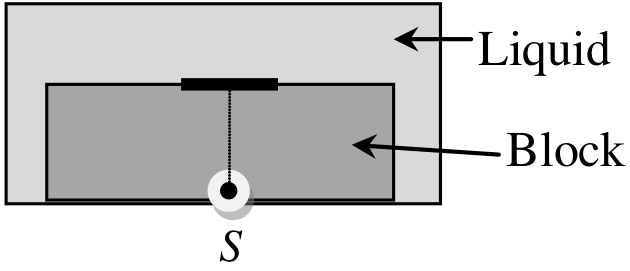
A point light source is situated at the bottom of a transparent block of height and refractive index . The block is submerged in a liquid with a lower refractive index, as shown in the diagram. It is found that the light emerging from the top surface of the block into the liquid forms a circular luminous region with a diameter of . The refractive index of the surrounding liquid is
Options
Topics & Concepts
Step-by-Step Solution
To find the refractive index of the surrounding liquid, we analyze the condition for total internal reflection at the interface between the transparent block and the liquid.
1. Geometric Analysis: A point source is situated at the bottom of a transparent block of height . Light rays emanate from in all directions. The rays incident on the top surface with an angle of incidence less than or equal to the critical angle will refract into the liquid, forming a circular luminous region. Rays with an angle of incidence greater than undergo total internal reflection.
The radius of the circular bright spot is related to the diameter by:
Notice that:
Thus, the tangent of the critical angle is:
This gives:
2. Application of Snell's Law: At the boundary between the block of refractive index and the liquid of refractive index , the critical angle satisfies:
Substituting the known values:
Therefore, the refractive index of the surrounding liquid is , which corresponds to Option (C).