Correct Molecular Orbital Diagram for Fluorine Molecule in Ground State
The correct molecular orbital diagram for molecule in the ground state is
Options
Topics & Concepts
Step-by-Step Solution
To determine the correct molecular orbital (MO) diagram for the fluorine molecule () in its ground state, we analyze the atomic electronic configuration, mixing, and electron filling according to the Aufbau principle, Pauli exclusion principle, and Hund's rule.
1. Electronic Configuration of Fluorine Atom
A fluorine atom () has the ground-state electronic configuration: Thus, each fluorine atom contributes valence electrons, giving a total of valence electrons for the molecule.
2. Relative Energy Levels of Molecular Orbitals ( Mixing)
For homonuclear diatomic molecules of period-2 elements heavier than nitrogen (e.g., and ), the energy difference between the and atomic orbitals is relatively large (). Consequently, mixing is negligible.
Without mixing, the bonding molecular orbital formed from orbitals () lies lower in energy than the bonding molecular orbitals ().
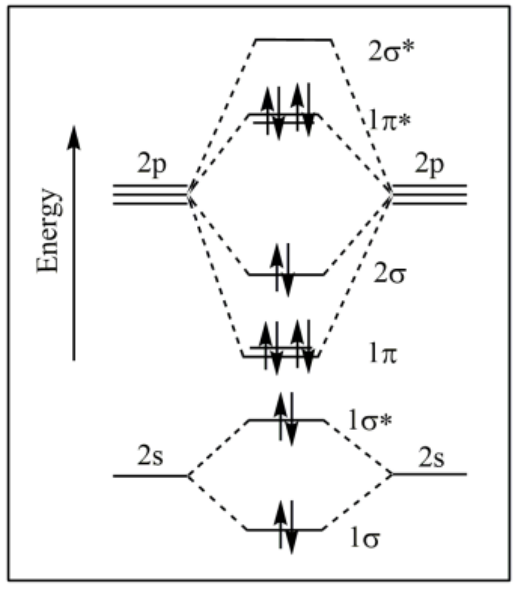
The relative energy sequence for the valence molecular orbitals in is:
3. Filling of Valence Electrons
Filling the valence electrons into the molecular orbitals in order of increasing energy:
- orbital receives electrons:
- orbital receives electrons:
- orbital receives electrons:
- orbitals (doubly degenerate) receive electrons:
- orbitals (doubly degenerate) receive electrons:
- orbital remains empty:
The complete valence ground-state electron configuration of is:
4. Comparison with the Options
- Option (A) correctly places below and fills , , , , and completely, leaving empty.
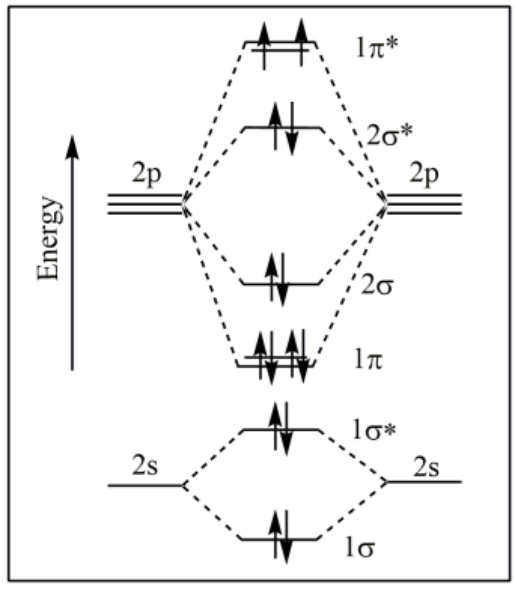
- Option (B) incorrectly places below and misallocates electron pairs.
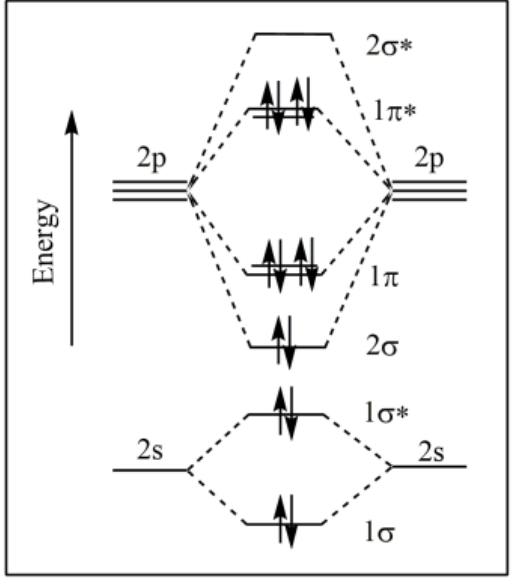
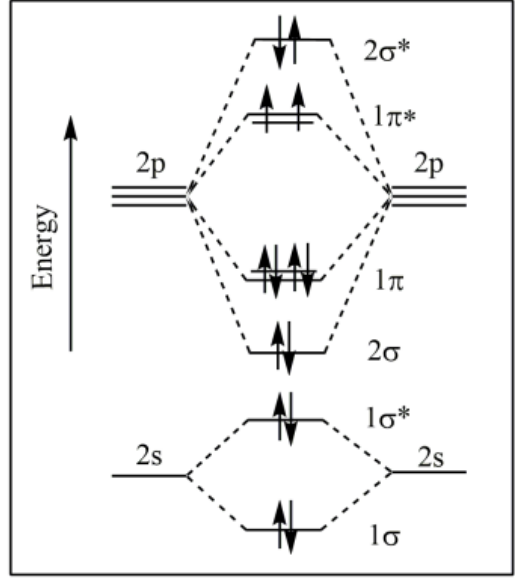
- Options (C) and (D) incorrectly show lower in energy than , which occurs only in molecules with significant mixing ().
Thus, the correct molecular orbital diagram is given by Option (A).