Apparent Frequency Detected from Circular Moving Sound Source
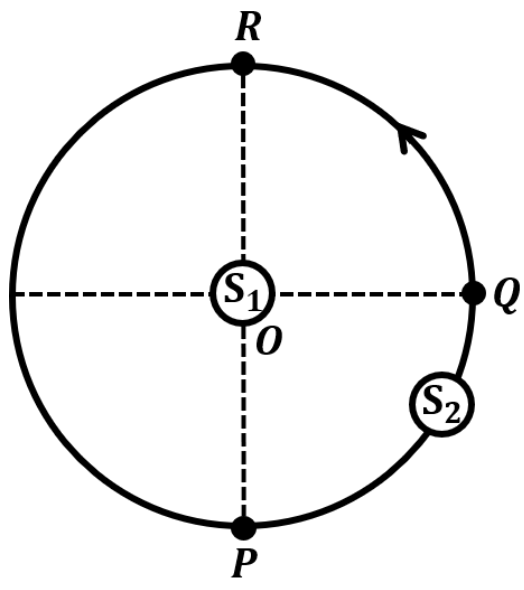
and are two identical sound sources of frequency . The source is located at and moves anti-clockwise with a uniform speed on a circular path around , as shown in the figure. There are three points , and on this path such that and are diametrically opposite while is equidistant from them. A sound detector is placed at point . The source can move along direction .
[Given: The speed of sound in air is ]
When only is emitting sound and it is at , the frequency of sound measured by the detector in Hz is ________.
Topics & Concepts
Step-by-Step Solution
To find the frequency of sound measured by the detector at point when source is at point , we use the Doppler effect formula for a moving source and a stationary observer.
1. Position and Velocity Analysis
Let the origin be the center of the circular path of radius .
-
Position vector of detector at :
-
Position vector of source at :
-
Vector from the source to the detector :
The unit vector pointing from the source to the detector is:
Since moves anti-clockwise on the circle with uniform speed , its velocity vector at point is along the positive -direction:
2. Velocity Component along Line of Sight
The component of velocity of the source directed towards the detector is given by:
Substituting the vectors:
The negative sign indicates that the source is moving away (receding) from the detector along the line of sight at a speed of .
3. Calculation of Apparent Frequency
Using the Doppler effect formula for a source moving away from a stationary observer:
Given data:
- Original frequency,
- Speed of sound in air,
- Receding speed of source,
Substituting the values:
Since :
648