Ratio of Work Done in Cyclic Processes I and II
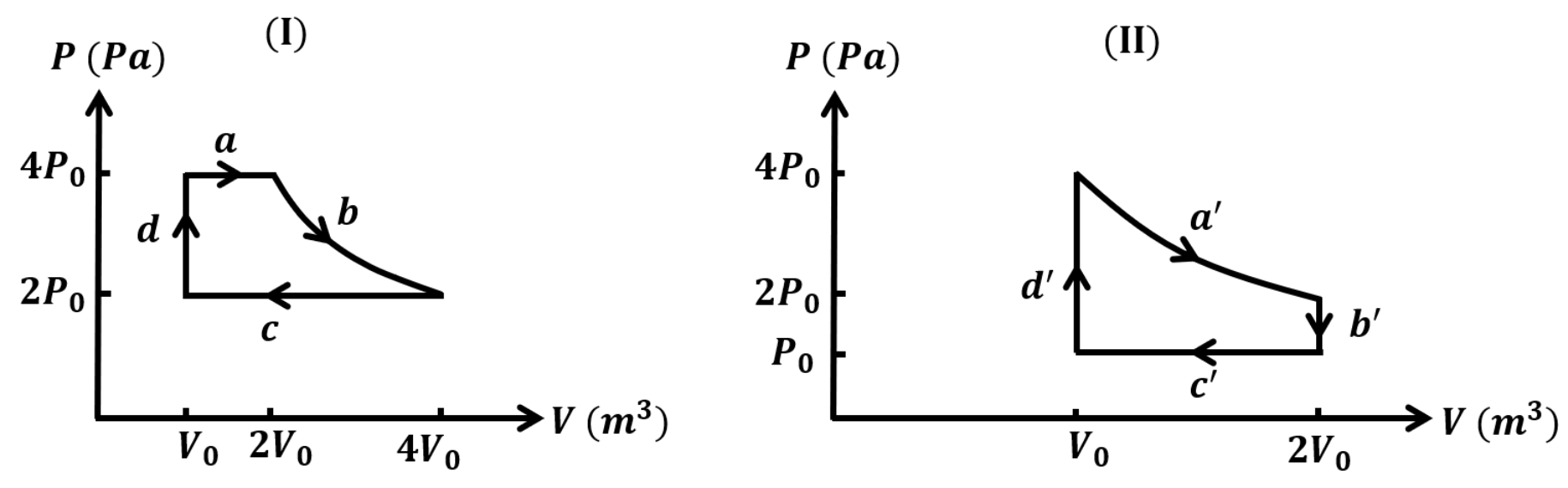
One mole of an ideal gas undergoes two different cyclic processes I and II, as shown in the - diagrams below. In cycle I, processes and are isobaric, isothermal, isobaric and isochoric, respectively. In cycle II, processes and are isothermal, isochoric, isobaric and isochoric, respectively. The total work done during cycle I is and that during cycle II is . The ratio is ________.
Topics & Concepts
Step-by-Step Solution
To find the ratio of the total work done in cycle I () to that in cycle II (), we calculate the work done in each individual thermodynamic process for both cycles.
1. Work Done in Cycle I ()
Cycle I consists of four processes:
-
Process (Isobaric expansion): The gas expands from volume to at a constant pressure .
-
Process (Isothermal expansion): The state changes from to . The product is constant throughout this process.
-
Process (Isobaric compression): The gas is compressed from to at a constant pressure .
-
Process (Isochoric process): The volume remains constant at while the pressure increases from to .
Summing the work done in all four processes for cycle I:
2. Work Done in Cycle II ()
Cycle II consists of four processes:
-
Process (Isothermal expansion): The state changes from to . The product is constant throughout this process.
-
Process (Isochoric process): The volume remains constant at while pressure drops from to .
-
Process (Isobaric compression): The gas is compressed from to at a constant pressure .
-
Process (Isochoric process): The volume remains constant at while pressure rises from to .
Summing the work done in all four processes for cycle II: