Apparent Depth Comparison in Glass Cylindrical Media with Different Curved Surfaces
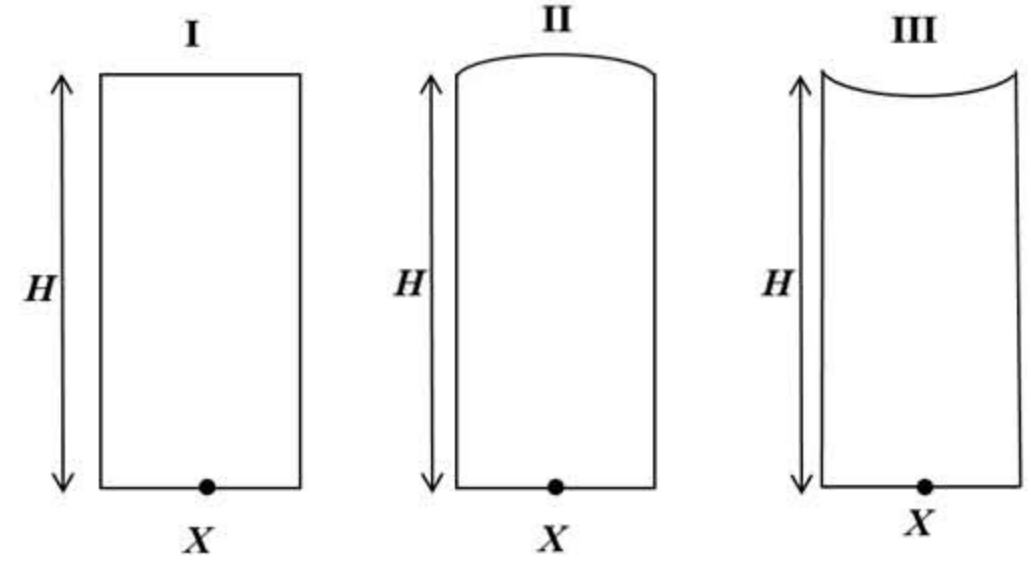
Consider three glass cylinders, each having an equal height and refractive index , resting on a horizontal base as shown in the diagram. Cylinder I has a flat upper surface, cylinder II has a convex upper surface, and cylinder III has a concave upper surface. The radius of curvature for both curved surfaces is . Let , , and represent the apparent depths of a point located at the bottom of the three cylinders, respectively. Identify the correct statement(s):
Options
Topics & Concepts
Step-by-Step Solution
To find the correct statements, we analyze the refraction of light at the top surface of each glass cylinder.
General Formula for Refraction at a Single Spherical Surface
The relation between object distance (), image distance (), refractive indices of the media, and radius of curvature () is given by:
Sign Convention:
- Light travels from point inside the glass () upwards into air (). Therefore, the upward direction is positive.
- The pole (vertex) of each top surface is taken as the origin.
- The object is located below the top surface, so the object distance is:
1. Cylinder I (Flat Top Surface)
For a flat surface, the radius of curvature . Substituting the values into the refraction formula:
Thus, the apparent depth is:
2. Cylinder II (Convex Top Surface)
For the convex upper surface, the center of curvature lies inside the glass (below the vertex). Since this direction is opposite to the upward path of incident light:
Applying the refraction formula:
Thus, the apparent depth is:
3. Cylinder III (Concave Top Surface)
For the concave upper surface, the center of curvature lies in air (above the vertex), which is in the direction of the incident light:
Applying the refraction formula:
Thus, the apparent depth is:
Analysis of Options:
- Option A: Since and , we have . (Correct)
- Option B: Since and , we have . (Incorrect)
- Option C: Since and , we have . (Correct)
- Option D: Calculating the difference : Since , this inequality is false. (Incorrect)
Correct Statements:
(A) and (C)