JEE Challenger
More from Wave Optics

Youngs Double Slit Experiment with Inclined Incident Parallel Beam

In a Young's double slit setup, the distance between slits is d=0.3 mmd = 0.3\text{ mm} and distance to the screen is D=1 mD = 1\text{ m}. Parallel light rays of wavelength 600 nm600\text{ nm} strike the slits at an angle α\alpha as depicted in the figure. Point OO on the screen lies equidistant from both slits, and the distance POPO measures 11.0 mm11.0\text{ mm}. Which of the following statements is/are correct?
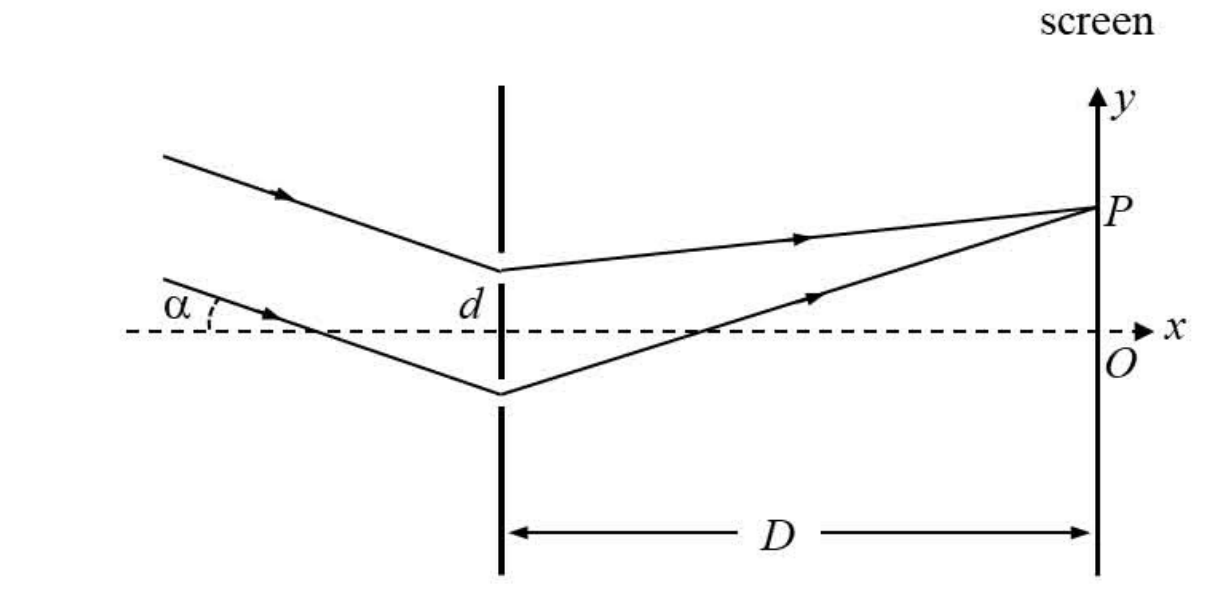
Question Diagram 1

Options

A

For α=0.36π\alpha = \frac{0.36}{\pi} degree, destructive interference occurs at point OO.

B

For α=0\alpha = 0, constructive interference occurs at point PP.

C

For α=0.36π\alpha = \frac{0.36}{\pi} degree, destructive interference occurs at point PP.

Correct
D

Fringe spacing depends on α\alpha.

Step-by-Step Solution

To determine the correct statement(s), we analyze the path difference for light waves passing through the two slits S1S_1 (upper slit) and S2S_2 (lower slit).

1. Path Difference Formula

When light rays are incident at an angle α\alpha relative to the principal axis:

  • The path difference introduced before reaching the slits is Δxinitial=dsin⁡α≈dα\Delta x_{\text{initial}} = d \sin\alpha \approx d\alpha (for small angles).
  • The path difference introduced after the slits for a point located at height yy above point OO on the screen is Δxfinal=ydD\Delta x_{\text{final}} = \frac{yd}{D}.

Thus, the net path difference Δx\Delta x at a point yy on the screen is given by: Δx(y)=∣dα−ydD∣\Delta x(y) = \left| d \alpha - \frac{yd}{D} \right|

Given parameters:

  • d=0.3 mm=3×10⁻⁴ md = 0.3 \text{ mm} = 3 \times 10^{-4} \text{ m}
  • D=1 mD = 1 \text{ m}
  • λ=600 nm=6×10⁻⁷ m\lambda = 600 \text{ nm} = 6 \times 10^{-7} \text{ m}

2. Analysis of Option A

For α=0.36π∘\alpha = \frac{0.36}{\pi}^\circ: Converting α\alpha to radians: α=0.36π×π180=2×10⁻³ rad\alpha = \frac{0.36}{\pi} \times \frac{\pi}{180} = 2 \times 10^{-3} \text{ rad}

The path difference introduced before the slits is: Δxinitial=dα=(3×10⁻⁴ m)×(2×10⁻³ rad)=6×10⁻⁷ m=600 nm\Delta x_{\text{initial}} = d\alpha = (3 \times 10^{-4} \text{ m}) \times (2 \times 10^{-3} \text{ rad}) = 6 \times 10^{-7} \text{ m} = 600 \text{ nm}

At point OO (y=0y = 0): Δx(O)=Δxinitial=600 nm=1⋅λ\Delta x(O) = \Delta x_{\text{initial}} = 600 \text{ nm} = 1 \cdot \lambda

Since the path difference is an integral multiple of λ\lambda, constructive interference occurs at point OO.
Therefore, Option A is incorrect.


3. Analysis of Option B

For α=0\alpha = 0 and at point PP (y=11.0 mm=11.0×10⁻³ my = 11.0 \text{ mm} = 11.0 \times 10^{-3} \text{ m}):

Δx(P)=ydD=(11.0×10⁻³ m)(3×10⁻⁴ m)1 m=3.3×10⁻⁶ m=3300 nm\Delta x(P) = \frac{yd}{D} = \frac{(11.0 \times 10^{-3} \text{ m})(3 \times 10^{-4} \text{ m})}{1 \text{ m}} = 3.3 \times 10^{-6} \text{ m} = 3300 \text{ nm}

Expressing Δx(P)\Delta x(P) in terms of wavelength λ\lambda: Δx(P)λ=3300 nm600 nm=5.5=(5+12)\frac{\Delta x(P)}{\lambda} = \frac{3300 \text{ nm}}{600 \text{ nm}} = 5.5 = \left( 5 + \frac{1}{2} \right)

Since the path difference is an odd multiple of λ2\frac{\lambda}{2}, destructive interference occurs at point PP.
Therefore, Option B is incorrect.


4. Analysis of Option C

For α=0.36π∘\alpha = \frac{0.36}{\pi}^\circ and at point PP (y=11.0 mmy = 11.0 \text{ mm}):

Δx(P)=∣dα−ydD∣=∣600 nm−3300 nm∣=2700 nm\Delta x(P) = \left| d\alpha - \frac{yd}{D} \right| = |600 \text{ nm} - 3300 \text{ nm}| = 2700 \text{ nm}

Expressing Δx(P)\Delta x(P) in terms of wavelength λ\lambda: Δx(P)λ=2700 nm600 nm=4.5=(4+12)\frac{\Delta x(P)}{\lambda} = \frac{2700 \text{ nm}}{600 \text{ nm}} = 4.5 = \left( 4 + \frac{1}{2} \right)

Since the path difference is an odd multiple of λ2\frac{\lambda}{2}, destructive interference occurs at point PP.
Therefore, Option C is correct.


5. Analysis of Option D

The position of the nthn^{\text{th}} bright fringe on the screen is given by: dα−ydD=nλ  ⟹  yn=Dα−nλDdd\alpha - \frac{yd}{D} = n\lambda \implies y_n = D\alpha - \frac{n\lambda D}{d}

The fringe spacing β\beta (distance between two consecutive bright or dark fringes) is: β=∣yn+1−yn∣=λDd\beta = |y_{n+1} - y_n| = \frac{\lambda D}{d}

Since β\beta depends only on λ,D,\lambda, D, and dd, it is completely independent of the angle of incidence α\alpha.
Therefore, Option D is incorrect.


Conclusion

The correct option is C.