De Broglie Wavelength of Photoelectrons Passing Through Anode
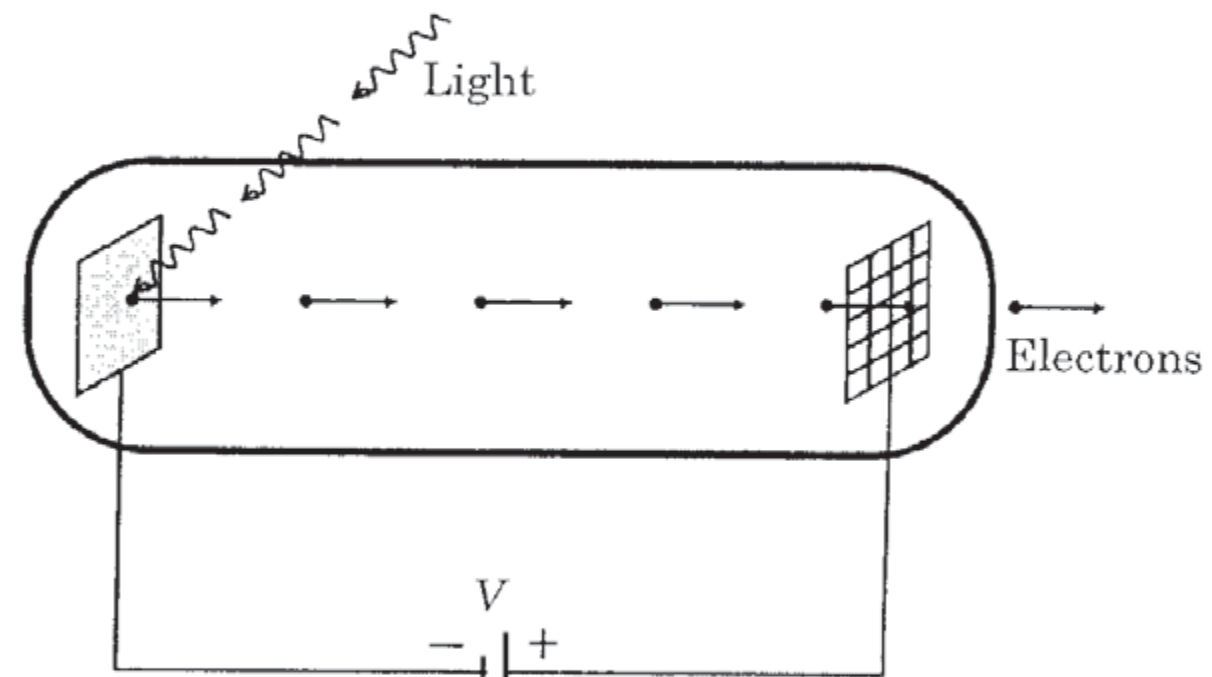
Light having wavelength strikes a cathode plate enclosed inside an evacuated tube as depicted in the diagram. The work function associated with the cathode surface is , while the anode consists of a conducting wire mesh positioned at a separation from the cathode. A potential difference is set up across the electrodes. Provided that denotes the minimum de Broglie wavelength of electrons crossing through the anode mesh, choose the correct statement(s):
Options
decreases with increase in and
is approximately halved, if is doubled
For large potential difference (), is approximately halved if is made four times
increases at the same rate as for
Step-by-Step Solution
To determine the correct statement(s), we begin by applying the photoelectric equation and the concept of de Broglie wavelength for the emitted photoelectrons.
1. Maximum Kinetic Energy of Photoelectrons
According to Einstein's photoelectric equation, the maximum kinetic energy of photoelectrons emitted at the cathode is given by:
As these photoelectrons travel from the cathode to the anode, they are accelerated through a potential difference . The energy gained by an electron of charge in this potential difference is .
Therefore, the maximum kinetic energy of the electrons reaching the anode mesh is:
2. Minimum de Broglie Wavelength
concentrated at the maximum kinetic energy, the minimum de Broglie wavelength corresponds to the electrons possessing the maximum momentum at the anode:
Substituting into the wavelength expression gives:
3. Evaluation of Options
-
Option (A): If or increases, the term decreases, which means decreases. Consequently, increases rather than decreases. Thus, Option A is incorrect.
-
Option (B): The expression for depends only on the potential difference , the work function , and the photon wavelength . It is completely independent of the distance between the cathode and anode. Thus, changing has no effect on . Thus, Option B is incorrect.
-
Option (C): For a large potential difference such that and , the kinetic energy contribution from the potential difference dominates:
Under this approximation, the minimum de Broglie wavelength simplifies to:
If the potential difference is increased to , the new wavelength becomes:
Therefore, is approximately halved when is quadrupled. Thus, Option C is correct.
-
Option (D): Differentiating with respect to yields:
Since , does not increase at the same rate as . Thus, Option D is incorrect.
Conclusion
The only correct statement is C.